

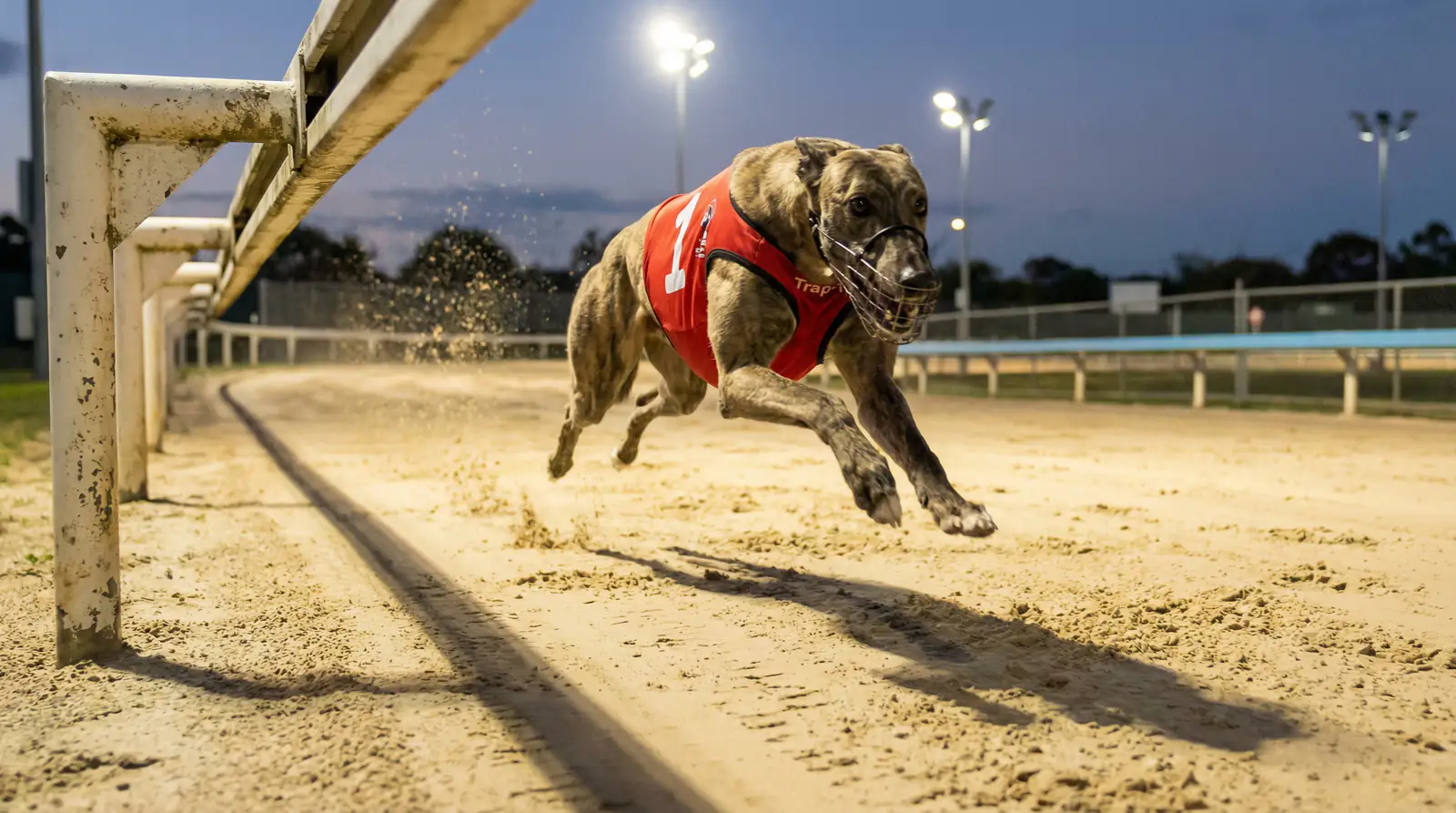
Form Is a System, Not a Guess
Every winning pick starts with the same thing — reading the form without bias. That sounds obvious, and it is. But greyhound betting is full of punters who pick a dog because they like the name, because it won last time, or because someone in the bar told them it was a certainty. Form analysis is the antidote to all of that. It’s a structured process for turning racecard data into an informed assessment of which dog is most likely to win, and — just as importantly — whether the odds on offer represent value.
Greyhound form analysis is more systematic than its horse racing equivalent, for one simple reason: the variables are fewer. Every race has six runners. Every race is on a flat, oval track. There are no jockeys making tactical decisions mid-race, no fences to jump, no going variations within the same course. The dog breaks from the trap, runs its line, and finishes. The data on the racecard — split times, bend positions, calculated times, remarks, weight, trap draw — captures nearly everything that happened. Your job is to read it, compare it across all six runners, and form a view.
The core framework has four pillars: speed, draw, run-style, and conditions. Speed is measured by calculated time and sectional splits. Draw is the trap position and its interaction with the dog’s natural running line. Run-style is whether the dog leads, tracks, or closes. Conditions mean the going, the weather, and the specific track. Every form assessment works through these four elements. The best pick isn’t always the fastest dog — it’s the dog whose combination of speed, draw, style, and conditions gives it the highest probability of finishing first.
Early Pace: The Single Most Important Factor
The dog that leads at the first bend wins more often than any stat would suggest. Across UK greyhound racing as a whole, the first-bend leader wins standard-distance races somewhere between fifty and sixty per cent of the time, depending on the track. At venues with a long run-up to the first turn — Doncaster, with its 105-metre approach, being the prime example — that percentage nudges higher. The reason is mechanical: a dog that reaches the first bend in front has the inside line, the shortest path around the turn, and clear air ahead of it. Every other dog has to run further, navigate traffic, or find a gap that may not exist.
Identifying early pace from the racecard is straightforward once you know where to look. The split time — the time recorded to a specific checkpoint, usually the first bend — is the primary metric. A dog that consistently records splits of 4.45 to 4.50 seconds in 483m races is a fast breaker. A dog showing 4.70 or slower is not reaching the first bend in front unless several quicker dogs stumble. Compare the splits of all six runners in a race, and the likely early leader identifies itself.
But raw split times need context. A dog might record a fast split from trap one (the inside) and a slower split from trap four (middle), not because it broke any differently but because the geometry changes. From the inside, the racing line to the first bend is shorter. From the middle or outside, the dog covers more ground to reach the same point. When assessing early pace, factor in the trap: a split of 4.52 from trap five is genuinely fast, because the dog had further to travel. A split of 4.48 from trap one is expected for a decent breaker.
The run-up distance at any given track amplifies or diminishes the importance of early pace. At tracks with a 60-metre run-up, the traps are close to the first bend and the pack arrives in a bunch — early pace matters, but the margins are tiny. At Doncaster, 105 metres gives fast breakers enough room to separate from the field before the turn. This is why Doncaster form analysis starts with the split. If two dogs are closely matched on CalcTm but one has a significantly faster average split, that dog has a structural edge at this track.
There’s a trap within this logic, though. Over-reliance on early pace leads to consistently backing favourites, because the market knows that fast breakers win often. The edge isn’t in identifying the fastest breaker — everyone can see that. The edge is in finding races where the likely early leader faces trouble (a rival with similar pace in the adjacent trap) or where a closer has been underpriced because the market doesn’t account for a plausible pace collapse scenario.
Trap Draw Analysis
Trap draw matters more in greyhound racing than post position does in any other sport. In a six-lane race on an oval track, the inside dog has the shortest path to the first bend and — if it breaks cleanly — the best opportunity to establish the rail and lead. The outside dog has the longest path but more room to run wide without interference. The middle traps are the most exposed to crowding from both sides. This isn’t theory. It’s geometry, and it plays out in the results thousands of times a week across UK tracks.
At UK greyhound tracks, dogs are seeded into traps based on their running style. Rails runners — dogs that naturally hug the inside line — are allocated traps one and two. Middle runners take traps three and four. Wide runners, who prefer to race on the outside, go into traps five and six. The seeding is done by the racing manager, who studies the dog’s form, its running remarks, and its historical trap performance. The system isn’t perfect — dogs don’t always run to type, and sometimes the available runners don’t fit neatly into three pairs — but it provides a framework for assessing whether a dog is comfortably drawn or awkwardly placed.
The interaction between trap draw and early pace is where the real analysis happens. A fast-breaking rails runner in trap one is in its ideal scenario: shortest path, fastest break, clear rail. That dog should lead to the first bend. But what if the fastest split in the race belongs to the dog in trap three? Now there’s a potential clash. The trap-three dog might try to cut across to the rail, creating traffic at the first turn. The trap-one dog might hold the rail but face pressure from inside. The dogs in traps four, five, and six might benefit from the chaos ahead of them. Reading the trap draw means anticipating these interactions, not just assessing each dog in isolation.
Trap changes between races deserve specific attention. A dog that won from trap two last week is now in trap five. The market might still price it as the likely winner based on its recent result, but the dynamics are entirely different. From trap five, that dog has further to travel, less chance of leading at the first bend, and a running line that doesn’t suit its rails preference. The form says winner. The draw says question mark. Resolving that tension is the essence of trap draw analysis.
When the Draw Overrides the Form
There are races where a slower dog in a better draw will beat a faster dog on the wrong side, and identifying those races is one of the most profitable skills in greyhound betting. The scenario is specific: a dog with modest CalcTms but a clean break and an ideal trap (typically trap one or two for a rails runner) faces a dog with superior times but an awkward draw (a railer drawn in trap four or five, or a wide runner squeezed into trap two).
The awkwardly drawn dog has to adjust its running line to suit a trap that doesn’t match its instinct. A railer in trap four will try to cut inside, losing ground and potentially causing interference. A wide runner in trap two might drift outward from the break, losing early momentum. In both cases, the dog’s natural speed is compromised by the mechanics of the start. The well-drawn dog, meanwhile, runs its preferred line from a comfortable position and reaches the first bend with minimal wasted movement.
The question of when to prioritise draw over speed doesn’t have a fixed answer, but a useful rule of thumb is this: if two dogs are within two or three lengths on CalcTm (roughly 0.15 to 0.25 seconds over 483m), the draw becomes the deciding factor. If the faster dog has a three-length or greater advantage on time, it’s probably fast enough to overcome the draw. But within that narrow band — where most competitive graded races sit — the draw tips the balance. Punters who learn to spot these situations, where the form says one thing and the draw says another, find value that the casual market misses.
Running Lines: Rails, Middle, and Wide
A railer in trap five is like a left-footed footballer on the right wing. Technically capable, but structurally disadvantaged. Running line preference is one of the most consistent traits a greyhound displays, and reading it from the racecard is essential for understanding how a race is likely to unfold.
A dog’s running line is its natural path around the track. Rails runners stick to the inside, taking the shortest route and hugging the curve of the bends. Wide runners swing to the outside, sacrificing distance for clear running space. Middle runners sit between the two, often tracking the leaders and looking for gaps. These aren’t tactical choices — greyhounds don’t think about racing lines mid-race. They’re instinctive patterns, shaped by temperament and early racing experience, and they’re remarkably persistent. A dog that runs the rail at age two will almost certainly still run the rail at age four.
Running line preferences show up in the form remarks. A dog coded RlsStt (rails to straight) consistently hugs the inside and takes the shortest path to the home straight. A dog marked VW (very wide) swings out around the bends, covering extra ground but avoiding traffic. Bmp and Crd remarks often correlate with running line mismatches — a railer drawn wide that cuts across the field and causes interference, or a wide runner boxed in by the rails that gets bumped at the first bend.
For form analysis purposes, the running line tells you two things. First, whether the dog is well drawn — a rails runner in trap one is perfectly placed; a rails runner in trap five has a problem. Second, how the dog is likely to interact with its neighbours. If two rails runners are in traps one and two, they’ll race side by side into the first bend — clean and parallel, with minimal interference. If a rails runner is in trap two and a middle runner in trap one, there’s a chance the middle runner drifts slightly off the rail, giving the railer room to squeeze through — or closes the gap and creates a check. These micro-interactions at the first bend often determine the outcome of the whole race.
Using Calculated Times to Compare Dogs
Calculated time strips out the weather. What’s left is the dog. Every greyhound result includes a raw finishing time — the actual clock reading from trap to line. But raw times are contaminated by track conditions. A heavy, slow track adds time; a fast, dry surface removes it. The going allowance, expressed in hundredths of a second, adjusts the raw time to produce the calculated time, or CalcTm — an estimate of what the dog would have run on a standard surface.
CalcTm is the only honest way to compare dogs across different meetings. A dog that ran 29.95 on a going of +15 recorded a CalcTm of 29.80. A dog that ran 29.70 on a going of -10 recorded a CalcTm of 29.80. Same adjusted speed, despite a quarter-second gap in raw time. If you compared the raw times, you’d think the second dog was clearly faster. It wasn’t — it just ran on a faster track.
When using CalcTm for form analysis, look at the trend across the last three or four runs rather than any single figure. A dog showing CalcTms of 29.75, 29.80, 29.78, and 29.82 is performing consistently. A dog with CalcTms of 29.60, 30.10, 29.75, and 30.05 is erratic — possibly affected by draw, traffic, or inconsistent fitness. Consistency in CalcTm is itself a form indicator. The reliable dog is easier to rate, easier to place in the context of the field, and less likely to produce a nasty surprise.
CalcTm has limitations. It doesn’t account for trouble in running — a dog that was baulked at the second bend ran a slower time than its ability warranted, and the CalcTm reflects the slower time. Some racecards use an asterisked CalcTm to indicate an adjusted figure that attempts to compensate for in-running interference, but these adjustments are estimates at best. The other limitation is cross-track comparison. CalcTm is standardised within a track, but a CalcTm of 29.80 at Doncaster doesn’t mean the same thing as 29.80 at Romford, because the track dimensions, surface, and calibration differ. For form analysis, stick to comparing CalcTms at the same venue.
Weight Trends and What They Signal
A kilo heavier or a kilo lighter — in greyhound racing, that’s the difference between a winner and a non-runner. Under GBGB rules, any dog that presents at kennelling more than one kilogram above or below its last recorded race weight is withdrawn. This hard limit means that every dog on the card is within a narrow band of its previous weight, but within that band the variations still tell a story.
A dog that has been steadily gaining weight across three or four runs — say, from 31.2kg to 31.5kg to 31.8kg — might be putting on muscle after a break, recovering from a minor injury, or simply eating well. A gradual increase isn’t inherently negative, but a sharp jump towards the top of the allowable range sometimes signals a dog that’s carrying extra condition and might not be at peak racing fitness. Conversely, a dog that’s been gradually losing weight — 32.0kg to 31.7kg to 31.4kg — could be getting leaner and fitter, which is often a positive sign, particularly if the CalcTms are improving in parallel.
The most informative weight reading is the one that breaks the pattern. A dog that has weighed 30.5kg for four consecutive runs and suddenly comes in at 31.2kg has changed something — diet, exercise, or health. That change might produce better or worse form, but it introduces uncertainty, and uncertainty is worth noting. Equally, a dog that has been fluctuating between 30.0kg and 31.0kg with no consistency is harder to rate than one holding a steady weight. Stability suggests routine, and routine tends to produce reliable form.
Weight is never the primary factor in picking a winner. It’s a supporting signal — something that confirms or complicates the picture painted by speed, draw, and running style. But ignoring it entirely means missing a data point that’s sitting right there on the racecard, and the punters who use every available data point tend to outperform those who don’t.
Trainer Patterns and Kennel Form
A hot trainer at Doncaster will win three or four in a night — and it’s rarely a coincidence. Greyhound trainers prepare multiple dogs, often running several on the same card. When a kennel is in form — dogs are fit, well-fed, and peaking at the right time — the results cluster. You’ll see the same trainer’s name appearing in the winner’s column across consecutive races. This isn’t luck. It reflects the condition of the entire kennel, and it’s a signal worth tracking.
Different trainers specialise in different ways. Some kennels are known for their sprinters, producing dogs that dominate over 275 metres but rarely compete at stayers’ distances. Others focus on middle-distance dogs for the standard 483-metre races that form the bulk of every card. A few develop genuine stayers for 661-metre and marathon events. Knowing which trainers target which distances at Doncaster helps you assess runners more quickly — a dog from a sprint-focused kennel entered in a 661m race is a question mark, even if its CalcTm looks competitive.
Trainer switches are one of the most underrated form indicators. When a dog moves from one trainer to another, it usually means something has changed — the owner is unhappy with results, the dog needs a different approach, or the previous trainer has a full kennel. The first run for a new trainer is often exploratory: the dog might be tried over a different distance, from a different trap, or at a different track. Results from that first run should be treated as preliminary. The second and third runs tell you whether the switch is working. A dog that shows improved CalcTms and better finishing positions after a trainer change is a dog on an upward trajectory, and the market sometimes takes a few runs to catch up.
Trainer statistics are available through the GBGB and through some specialised form services. At Doncaster, where the same trainers run dogs week after week, you can build a working knowledge of kennel tendencies just by following results across a few months of meetings. That kind of familiarity — knowing that a particular trainer’s dogs tend to peak in certain conditions, or that a kennel has been on a winning streak — doesn’t show up on the racecard, but it informs how you weight the data that does.
Putting the Picture Together
You’ve read the times, checked the draw, noted the trainer — now make the call. Form analysis isn’t useful until it produces a decision, and the decision process works best when it follows a sequence. The sequence isn’t rigid, but it gives you a repeatable framework that works across any race on any card.
Start by eliminating the no-hopers. In most graded races, one or two dogs are clearly outclassed — their CalcTms are half a second or more slower than the rest of the field, their recent form shows consecutive finishes in fifth and sixth, and they’re drawn awkwardly. These dogs are in the race to make up the numbers. Cross them off. You’re now comparing four dogs instead of six, which is a much more manageable task.
Next, identify the contenders on speed. Of the remaining four, which two or three have the best CalcTms? These are the dogs that should be competitive based on raw ability. Rank them by their average CalcTm over the last three runs, not their best single time. The average gives you a more reliable picture of current form than a peak figure that might have been achieved in perfect conditions.
Now overlay the draw. Among your speed contenders, which is best drawn? A dog with the second-fastest CalcTm but a perfect draw (rails runner in trap one, wide runner in trap six) may be a better bet than the fastest dog in the field drawn against its preference. Check whether any of the contenders have been moved to a new trap — a shift from inside to outside or vice versa introduces risk that the CalcTm alone doesn’t capture.
Check for trouble risk. Look at the traps adjacent to your top pick. If the dog next door has a reputation for slow breaks (SAw remarks) or drifting off its line (VW, Crd), your dog might face interference. If the neighbouring dogs are clean runners with predictable styles, the risk is lower. This step is about anticipating the first bend — the moment where most greyhound races are won or lost.
Finally, look at the odds. You’ve identified the dog most likely to win based on form, draw, and race dynamics. Now ask: does the price reflect that probability, or does it exceed it? If your analysis says a dog has roughly a one-in-three chance of winning and the bookmaker is offering 4/1, you’ve found value. If the same dog is 6/4, the market has already priced in its chances, and the value may lie with a less obvious contender. The form analysis picks the dog. The odds analysis picks the bet.
The Form Reader’s Edge
Greyhound form doesn’t lie — but it does require translation. The racecard is a record of what happened. Form analysis is the discipline of understanding why it happened and what it means for the next race. Those are different skills, and the second one only develops with practice.
The good news is that greyhound form analysis compounds. Every meeting you study teaches you something — about a trainer, about a trap position at a specific track, about how a particular dog handles different distances. The knowledge accumulates and becomes intuitive. After fifty meetings at Doncaster, you’ll start recognising dogs by their running style before you’ve even looked at the numbers. After a hundred, you’ll have a mental database of trainers, tendencies, and track conditions that no racecard can replicate.
There’s no shortcut to that level of familiarity, and there’s no substitute for the feedback loop of analysis, prediction, and result. Study the card. Make your picks. Watch the race. Review what happened. Adjust your process. The punter who does this consistently, week after week, develops an edge that the casual bettor never will. It’s not dramatic, and it won’t make you rich overnight. But it’s real, it’s repeatable, and it’s available to anyone willing to put in the time.
