

- Meadow Court: Doncaster’s Dog Track
- Track Layout and Dimensions
- Race Days, Fixtures and Schedule
- Facilities: What to Expect on Race Night
- Getting to Doncaster Greyhound Stadium
- History: From Speedway Cinders to Racing Sand
- Key Competitions and Events at Doncaster
- Doncaster vs Other UK Dog Tracks
- Where Stainforth Sand Meets the Starting Traps
Meadow Court: Doncaster’s Dog Track
Stainforth isn’t a destination — but on race nights, Meadow Court Stadium makes it one. Tucked between the M18 motorway and the flat South Yorkshire farmland two miles east of Junction 4, Doncaster Greyhound Stadium sits in the kind of place you’d drive past without a second glance. There’s no grand entrance, no city-centre glamour, no tourist appeal. What there is, six days a week, is a working greyhound track that has been racing since 1993 and draws punters from across Yorkshire and beyond.
The stadium was built by Chick Hicken, a name well known in British greyhound racing, at a cost of roughly 1.5 million pounds. It replaced what had been, for decades, a derelict site with a tangled history — speedway, whippet racing, flapping greyhound meetings, closure, and then silence. Hicken’s investment turned it into a licensed GBGB track with a proper grandstand, a restaurant, bars, and a sand racing surface that has since become one of the most distinctive in the country. The stadium was originally known as Stainforth Stadium before rebranding as Doncaster Greyhound Stadium in 2006, a change that better reflected its catchment and ambition.
The capacity is around 1,500, and on a good Saturday evening the place fills up with a mix of regulars who know every trainer’s name and newcomers drawn by a night out that still costs less than a cinema trip for two. It’s not Romford, with its RPGTV cameras and national profile. It’s not the defunct White City, with its legends and ghosts. Doncaster is something else — a track that thrives on consistency, racing more meetings per week than most of its rivals and quietly producing some of the most form-reliable results in UK greyhound racing.
Track Layout and Dimensions
At 438 metres round, Doncaster sits in the mid-range of UK tracks — but that 105-metre run to the first bend is what defines it. Most UK greyhound stadiums have a run-up between 60 and 90 metres. Doncaster’s extra distance from the traps to the first turn gives fast breakers more time to establish position, and it means that the first bend at this track is less congested than at tighter venues. Dogs that show early pace have a genuine structural advantage here, and the form data bears that out consistently.
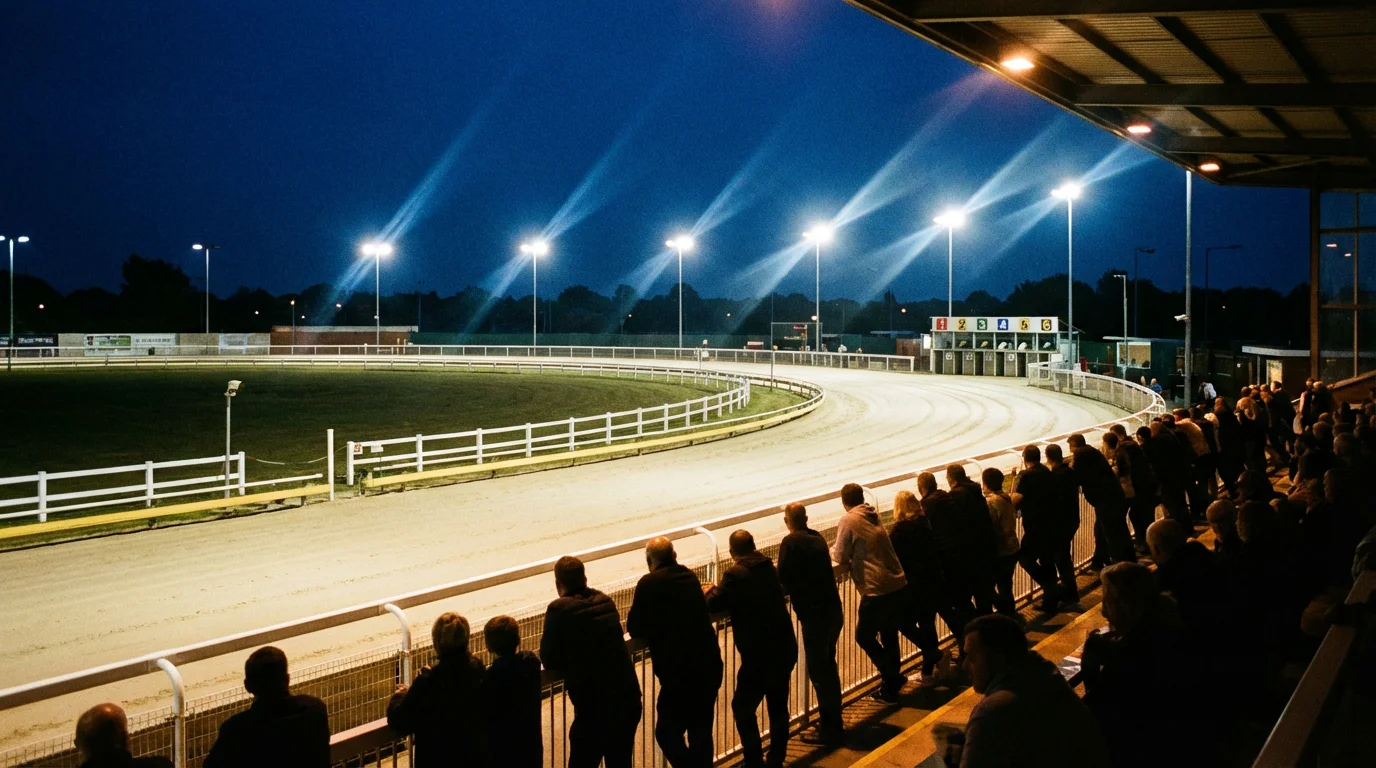
The track is a standard oval with four bends, an outside hare system (the mechanical lure runs on a rail outside the racing line, a Swaffham type), and a sand surface. Sand tracks generally produce slightly slower times than all-weather or turf surfaces, but they’re more forgiving on joints and paws — a factor that matters over a dog’s career. Doncaster’s sand is maintained between meetings, and its consistency varies with weather. Heavy rain slows the surface; dry spells speed it up. The going allowance published before each meeting reflects these conditions, and regular punters learn to read the relationship between weather forecasts and track speed.
Four standard race distances are offered: 275 metres for sprints, 483 metres for the standard distance that forms the bulk of every card, 661 metres for stayers, and 705 metres for the occasional marathon event. The 275m sprint is essentially a dash to the first bend and a short gallop around two turns — raw trap speed is everything. The 483m is the workhorse distance, taking dogs around the full circuit with enough straight running to allow both front-runners and closers a chance. The 661m and 705m races add an extra half-circuit or more, testing stamina and composure in ways that shorter races never do.
Compared to the UK average, Doncaster’s circumference is unremarkable. Romford is tighter at 350 metres. Nottingham is wider at 437 metres. Monmore sits at 419. What makes Doncaster distinctive isn’t the total distance around the track but the geometry of the run-up and the bend profiles. The long run to the first bend and the relatively open bends mean that dogs with pace and a clean break are rewarded more generously here than at tracks where the first turn comes quickly and crowding is almost guaranteed.
Race Days, Fixtures and Schedule
Six meetings a week — Doncaster doesn’t rest. The standard schedule runs Monday afternoon with a first race around 14:33, Tuesday evening from approximately 18:04, Wednesday evening at the same time, Saturday morning from approximately 11:13, Saturday evening from around 18:11, and Sunday morning from about 11:04. Each meeting typically features twelve races, occasionally more, running at regular intervals across two to three hours. The schedule shifts slightly for bank holidays and special events, but the core rhythm is remarkably stable.
That frequency matters for punters. Six meetings a week means the same dogs return to the track regularly, often running once every four to seven days. This produces fresh, recent form data at a rate that most horse racing venues can’t match. A dog that raced at Doncaster on Monday will have updated form by Saturday, and by the following Wednesday you might have three new data points to work with. For anyone who builds their betting around form analysis, this density of information is a significant advantage.
The afternoon meetings (Monday) and weekday evenings (Tuesday and Wednesday) tend to be quieter, drawing a smaller crowd and sometimes weaker on-course tote pools. The Saturday evening fixture is the flagship meeting — higher attendance, better atmosphere, and often stronger graded cards. Sunday mornings attract a specific crowd of committed regulars who prefer the quieter setting. For remote bettors, the time slot matters less than the quality of the card, but it’s worth knowing that Saturday evening races at Doncaster frequently feature the track’s best dogs and the most competitive open events.
Fixture lists are published in advance by the stadium and by the GBGB. Checking the upcoming schedule is straightforward — the Doncaster Greyhound Stadium website and most major bookmaker sites list fixtures, race cards, and going reports before each meeting.
Facilities: What to Expect on Race Night
Four bars, a restaurant, and a grandstand with views across the whole track. Meadow Court isn’t the most lavish greyhound stadium in the UK, but it covers the essentials well and has the kind of no-nonsense functionality that regular racegoers appreciate more than occasional visitors might expect.
The grandstand is the centrepiece — a three-storey structure with tiered seating that overlooks the home straight and gives a clear sightline to the first and second bends. The ground floor houses the main bar and snack bar, where you can get a drink and a burger without missing a race if you time it right. The first floor is home to the restaurant, which offers a carvery service on most race nights and is the closest thing the stadium has to a formal dining experience. It’s decent, unpretentious food served with a view of the track, and it’s popular enough that booking in advance is advisable for Saturday evenings. The upper level includes executive suites available for private hire — corporate events, birthday parties, stag dos, and the like.
Betting on-site is handled by a combination of on-course bookmakers and the tote. The tote windows offer pool betting on individual races and across the card (Jackpot, Pick 6, Straight 4), while the bookmaker pitches provide fixed-odds betting at starting price or early show. The atmosphere around the bookmaker ring on a busy Saturday night is part of Doncaster’s appeal — there’s an energy to trackside betting that screen-based wagering doesn’t replicate.
The car park accommodates around 500 vehicles and is free. For anyone with mobility requirements, the stadium has wheelchair access and a lift to upper levels. The facilities are functional rather than glamorous, but they do the job — you can spend three hours here comfortably, whether you’re watching from the rail with a pint or eating upstairs with a table overlooking the finish line.
Entry Prices, Packages and Deals
Standard admission is around five pounds fifty, though prices can vary for special events and promotions. For that, you get access to the grandstand, the bars, and the trackside viewing areas. It’s one of the cheapest live sporting experiences in the country, and it’s worth remembering that when comparing it to a football match or even a trip to the cinema.
Packages that combine entry with a carvery meal are available on most race nights, typically for somewhere between fifteen and twenty-five pounds per person depending on the day and the menu. Saturday evening packages tend to be the most popular — and the most likely to sell out, so booking ahead is the sensible move. The stadium also runs periodic promotions: Boxing Day meetings, New Year fixtures, and occasional themed events that draw bigger crowds and sometimes enhanced tote pools. Details and booking are handled through the stadium directly.
For groups, the executive suites offer private viewing with catering included, though the cost steps up accordingly. If you’re organising a works do or a birthday celebration and want something different from the usual bar or restaurant, a greyhound night at Doncaster is a well-worn option in South Yorkshire — affordable, entertaining, and finished by ten o’clock.
Getting to Doncaster Greyhound Stadium
M18 Junction 4 — two miles and you’re there. By car, the stadium is straightforward to reach from anywhere with motorway access. From the south, take the M1 north to the M18 junction, then follow the M18 east to Junction 4 and head towards Stainforth. From the north, the A1(M) connects to the M18 at Junction 5, or you can approach via the M62 and M18. The postcode for sat-nav is DN7 5HS, and from the motorway junction the drive takes about five minutes in normal traffic. Parking at the stadium is free and rarely full except on major event nights.
By train, the nearest station is Hatfield and Stainforth, which is on the Northern Trains route between Doncaster and Scunthorpe. The walk from the station to the stadium is roughly ten minutes. Doncaster station itself, a major hub on the East Coast Main Line, is about eight miles away — too far to walk, but a short taxi ride or bus journey. Several bus routes pass through Stainforth and stop within walking distance of the stadium, including the 84, 84a, 87, 87a, 457, and 555 services, though evening frequency can be limited. If you’re relying on public transport for an evening meeting, check return times before you go.
The practical reality is that most people drive. The M18 access makes it easy from Sheffield, Rotherham, Barnsley, Wakefield, and the wider Yorkshire region. On a clear evening, you can be in Stainforth from central Doncaster in fifteen minutes, from Sheffield in about forty, and from Leeds in just over an hour.
History: From Speedway Cinders to Racing Sand
The land under Meadow Court started as marshland, became a speedway track, went derelict — and came back as a greyhound stadium. It’s a story that sounds implausible, but it’s typical of British greyhound racing, where venues have often been built on sites that nobody else wanted.
The earliest recorded sporting use of the Stainforth site dates to 1929, when a speedway track was laid on cinder and dirt. Speedway was booming in the late 1920s, and small-town tracks popped up across the industrial north of England. The Stainforth venue ran motorcycle racing and, by some accounts, whippet racing on the same evenings — a combination that would have been unremarkable at the time, when working-class entertainment was local and improvisational.
By 1941, greyhound racing had taken over from speedway at the site, initially as unlicensed “flapping” meetings. Flapping tracks operated outside the National Greyhound Racing Club’s jurisdiction — no official grading, no regulated tote, no oversight beyond whatever the promoters chose to impose. This was common across northern England and continued at Stainforth for decades. The dogs were often locally owned, the crowds were local, and the betting was informal. It was greyhound racing at its most grassroots.
The flapping operation closed in 1978, and the site fell into disrepair. For fifteen years, it sat unused — a patch of scrubland with remnants of a track and no obvious future. That changed in 1993 when Chick Hicken, who had built greyhound venues elsewhere in the country, invested approximately 1.5 million pounds to construct Meadow Court Stadium from scratch. The new facility included a proper sand track, a three-storey grandstand, a restaurant, and — critically — a GBGB licence that brought the venue under the sport’s official regulatory umbrella. Licensed racing meant official grading, regulated betting, published results, and the credibility that comes with governance. It was a transformation from backyard flapping to professional greyhound sport.
The stadium rebranded from Stainforth Stadium to Doncaster Greyhound Stadium in 2006, aligning itself with the larger town name for marketing purposes. Since then, it has steadily built its fixture list and reputation, adding flagship competitions to the calendar and raising its profile beyond the immediate Yorkshire region. Today, Doncaster operates as one of the busiest greyhound tracks in the UK by fixture count, racing more meetings per week than most of its peers.
Key Competitions and Events at Doncaster
The Yorkshire St Leger puts Doncaster on the national greyhound map once a year. Established in 2004, the St Leger is a stayers’ competition run over 661 metres that attracts entries from across the UK. It’s the track’s showpiece event, the one that brings outside trainers, visiting dogs, and broader media attention. For punters, the St Leger rounds offer some of the most competitive racing on the Doncaster calendar — higher-quality fields, less predictable outcomes, and bigger-than-usual tote pools.
The TV Trophy, introduced in 2008, is another notable competition. It brought televised coverage to Doncaster, exposing the track to a wider betting audience beyond the regular Yorkshire crowd. Televised races tend to generate more bookmaker interest and better early prices, which benefits remote bettors who prefer to take odds in advance rather than relying on SP.
The Trainers Championship, added to the calendar in 2010, takes a different format — it’s a team event that pits kennels against each other across multiple races. It doesn’t carry the prestige of the St Leger, but it creates a different kind of betting interest, particularly for punters who follow trainer form closely and can identify which kennels are likely to field their strongest strings.
Beyond these named events, Doncaster runs regular open races (OR1, OR2, OR3) throughout the year. Open races sit above the standard grading ladder and attract the best dogs at the track — and sometimes visiting challengers from other venues. For betting purposes, open races are where you find the highest quality and often the most efficient market (because the dogs are better known and more heavily analysed). They’re also where forecast and tricast dividends can surprise, because the margins between the top dogs are slim and minor upsets are common.
Doncaster vs Other UK Dog Tracks
How does Doncaster stack up against the big names — and does it matter? If you’re betting at Doncaster specifically, comparisons with other venues might seem academic. But understanding where Doncaster sits in the landscape of UK tracks helps you interpret form from visiting dogs and make sense of times recorded elsewhere.
Romford, in east London, is probably the most televised track in the country and the one that casual fans know best. It’s a tight circuit at 350 metres with a shorter run-up to the first bend, which means crowding at the first turn is more frequent and early pace is less decisive. A dog that dominates from the front at Doncaster might struggle at Romford, where the geometry punishes anything other than a perfect break. Conversely, a Romford dog that shows tactical speed and bend craft may find Doncaster’s long run-up gives it even more time to establish a lead.
Nottingham, running at 437 metres circumference, is one of the larger UK tracks and produces faster times at standard distances. Its wider bends and longer straights suit galloping types — dogs that build speed gradually rather than exploding from the traps. Comparing CalcTms between Doncaster and Nottingham requires caution; the tracks favour different running styles, and a time that’s competitive at one may not translate directly to the other.
Monmore Green in Wolverhampton, at 419 metres, is closer to Doncaster in size and character. Both are sand tracks with working-class roots and loyal local followings. Monmore’s run-up is shorter, so early pace matters slightly less there, but the overall racing dynamic is similar enough that dogs transferring between the two tracks tend to adapt quickly.
What Doncaster offers that many other tracks don’t is sheer frequency. Six meetings a week means more racing, more form data, and more opportunities for punters who specialise. Some bigger-name tracks run three meetings a week or fewer. For anyone who builds their approach around volume of data and consistent conditions, Doncaster’s schedule is a genuine asset.
Where Stainforth Sand Meets the Starting Traps
It cost 1.5 million pounds in 1993 and it’s still paying out. Not literally — Meadow Court isn’t a money-printing machine, and plenty of punters leave lighter than they arrived. But the investment that Chick Hicken made in a patch of derelict Stainforth land three decades ago created something that endures: a working greyhound stadium with a full fixture list, a loyal following, and a racing surface that produces form worth studying.
Doncaster will never compete with the big London tracks for television time or prestige. It doesn’t need to. Its appeal lies in regularity, accessibility, and the kind of track-specific knowledge that rewards attention. The dogs run here six times a week, the trainers are familiar, the distances are consistent, and the sand tells the same story meeting after meeting — with just enough variation from weather and going to keep it interesting.
Whether you visit in person on a Saturday evening or follow the results from a screen at home, Doncaster Greyhound Stadium is a track worth knowing. The more you learn about it — its dimensions, its history, its rhythms — the better equipped you are to read its results and find value in its races. That’s the quiet advantage of a venue like Meadow Court. It doesn’t shout for attention. It simply runs, and it rewards the people who pay close enough attention to listen.
