

Why Trap Position Matters More Than You Think
Ask any seasoned greyhound punter what the three most important factors in picking a winner are, and you will hear the same answer: draw, draw, and draw. It sounds like an exaggeration. It is not. The trap a greyhound starts from shapes the entire race — its route to the first bend, its likelihood of encountering interference, and its chance of establishing position. In a sport where races are decided by fractions of a second, the starting position is the first variable that determines the outcome.
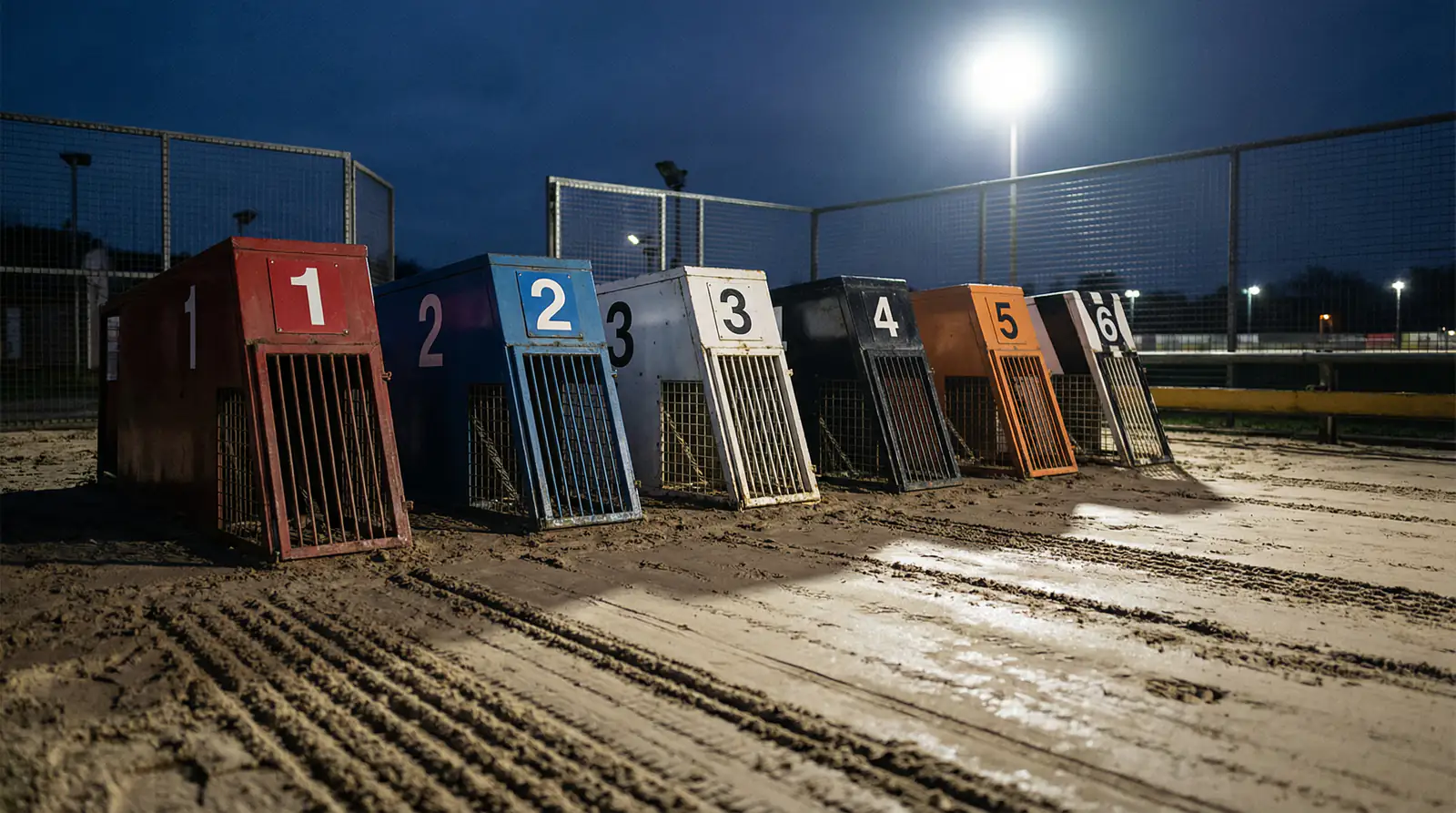
UK greyhound races feature six dogs, each starting from a numbered trap. Trap 1 sits closest to the inside rail, Trap 6 on the outside. Each trap is identified by a colour that the dog wears during the race: red for Trap 1, blue for Trap 2, white for Trap 3, black for Trap 4, orange for Trap 5, and black-and-white stripes for Trap 6. These colours are standardised across all licensed tracks and are as much a part of the sport’s identity as the racing itself.
The significance of the draw comes down to geometry and physics. Greyhound tracks are ovals, which means the first bend arrives quickly after the traps open. The dog on the inside has the shortest route to that bend. The dog on the outside has the longest. When six dogs are sprinting flat out toward the same piece of track, the one that has to cover less ground has a measurable advantage — provided it has the speed and running style to exploit it.
But the draw is not just about distance. It is about running lines, interference, and the interaction between six individual animals whose racing preferences are known and documented. The seeding system — which assigns dogs to traps based on their running style — is supposed to minimise crowding and maximise fair competition. In practice, it creates a puzzle that punters can solve more accurately than the odds suggest.
The run-up to the first bend varies significantly between tracks, and this variation changes how much the draw matters. At Doncaster, the run is 105 metres, which is relatively long. This gives dogs more time to sort themselves out before the bend, which slightly dilutes the inside trap advantage. At tracks with shorter run-ups, the inside traps dominate even more heavily. Knowing the characteristics of the track you are betting on is essential to assessing how much weight to give the trap draw in your analysis.
Inside vs Outside: Rails, Middle, Wide
Greyhounds are categorised by their preferred running position: rails, middle, or wide. This classification appears on the racecard as an indicator next to the dog’s name — typically “(W)” for a wide runner or “(M)” for a middle runner, with no marker for rails dogs since inside running is the default assumption. This seeding information is the key to understanding what the draw means for each individual runner.
A rails runner is a dog that naturally gravitates toward the inside of the track. These dogs want to hug the rail, take the shortest route around every bend, and save ground wherever possible. When a confirmed railer is drawn in Trap 1, it has the ideal setup — a straight path to the inside rail with no dog between it and its preferred running line. Drawn in Trap 5 or 6, that same railer has a problem. It needs to cross the paths of several dogs to reach the rail, and that crossing attempt creates exactly the kind of interference that costs positions.
Wide runners prefer the outside of the track. They swing around bends on the far side, covering more ground but avoiding the congestion that often occurs on the inside. A wide runner in Trap 6 has a clear path to its natural position. In Trap 1, it either has to break extremely fast to cross to the outside before the bend, or it gets trapped on the rail where it does not want to be.
Middle runners sit between these extremes. They are generally the most versatile, capable of adjusting their position depending on how the race unfolds. A middle-seeded dog in Trap 3 or 4 has reasonable access to its preferred line without needing to cross traffic. The middle traps are sometimes called the most neutral positions in the draw, though “neutral” should not be confused with “irrelevant.”
The interaction between seeding and trap is where the real analysis begins. A race where every dog is drawn in a trap that suits its running style will tend to produce a clean, formful result. A race where two railers are drawn in Traps 5 and 6 while a wide runner sits in Trap 1 is likely to produce chaos at the first bend — and chaos means opportunity for the punter who spots it. Before you look at times, weights, or grades, look at the draw. Ask whether each dog can reach its preferred running line without interference. The answer to that question predicts the first bend, and the first bend predicts the race.
Trap Statistics: What the Numbers Show
Every UK greyhound track accumulates data on trap performance over thousands of races, and the patterns that emerge are consistent enough to inform betting strategy. At most tracks, Trap 1 wins more races than any other trap over standard distances. The advantage is not overwhelming — Trap 1 might win 19 or 20 percent of races where random distribution would predict about 16.7 percent — but over a large enough sample, it is real and persistent.
The inside trap advantage is a direct consequence of track geometry. The dog on the inside has less ground to cover to reach the rail, and the rail provides a natural guide that helps the dog maintain its running line through the bends. Dogs on the outside have to work harder to hold their position and are more vulnerable to being carried wide by the centrifugal force of the bend.
At Doncaster specifically, the 105-metre run to the first bend slightly moderates the inside bias compared to tracks with shorter run-ups. With more room to sort out before the first bend, outside dogs have a marginally better chance of establishing position. But the fundamental advantage still favours the inside, particularly in sprint races where the entire race is decided in the first two bends.
Trap statistics become more useful when you go beyond the simple win percentage and look at performance by distance category. At most tracks, the inside trap advantage is strongest in sprints and weakest in stayers races. Over longer distances, there are more bends and more time for the field to spread out, which dilutes the initial advantage. A dog drawn in Trap 6 for a 660-metre race has six bends to work into position, whereas the same dog in a 275-metre sprint has only two bends and almost no time to recover from a poor start.
Do not treat trap statistics as a standalone betting system. Backing Trap 1 blindly across a full card will lose money, because the odds already reflect the trap advantage to some degree. The market knows that Trap 1 wins more often. What the market does not always account for is the specific interaction between a particular dog’s running style and its draw for a particular race. That is where the value lies — not in the aggregate statistics, but in the individual race assessment.
When a Dog Switches Traps
One of the most underrated form indicators in greyhound racing is a trap switch. When a dog that has been running from Trap 1 for its last four races suddenly appears in Trap 5, the change is worth attention regardless of what the rest of the form looks like.
A dog moving from an inside trap to the outside may have been reseeded by the racing manager — perhaps its running style has shifted, or it has shown a tendency to drift wide in recent races. Alternatively, the draw may simply be the product of the specific field assembled for that race. Either way, the change creates uncertainty. A dog that has built its recent form from a favourable inside draw is now being asked to perform from a completely different starting position, against a field of dogs whose running lines may create entirely different traffic patterns.
The reverse is equally significant. A dog that has been struggling from outside traps and is now drawn inside may have been disadvantaged by its previous draws rather than genuinely poor. Its form figures might show a string of fourth and fifth-place finishes, but if every one of those runs came from Trap 5 or 6 while the dog is a natural railer, those finishes are misleading. The first run from an inside trap could produce a dramatically different result.
The racecard always shows which trap the dog ran from in each of its previous races. Cross-referencing trap history with finishing positions is one of the most productive exercises in greyhound form study. A dog that finishes first or second every time it draws inside but fades from outside traps is telling you something clear and actionable: back it when the draw favours it, oppose it when the draw does not.
Trainers and racing managers are aware of these patterns, of course, and the seeding system is designed to match dogs with appropriate traps. But the system is not perfect, and on any given night there will be dogs in draws that do not suit them. Finding those mismatches is a skill that separates profitable bettors from recreational ones.
The Trap Is the First Bet You Make
Before you have studied the form, compared the times, or assessed the going, the trap draw has already tilted the race in one direction. It is the first piece of information on the racecard and it should be the first thing you evaluate.
This does not mean the draw overrides everything else. A clearly superior dog can win from any trap, and plenty of races are decided by ability rather than starting position. But in the majority of graded races — where the dogs are close in quality, because the grading system is designed to make them close — the draw is often the decisive marginal factor. When two dogs have similar times, similar form, and similar running styles, the one with the better draw wins more often than chance alone would predict.
Make it a habit. Every time you open a racecard, before you read the form or check the prices, scan the draw first. Identify which dogs have traps that suit their running style and which are compromised. Then read the form through that filter. You will find that many puzzling results — dogs with good form finishing poorly, outsiders winning at big prices — make perfect sense once you account for the draw.
The trap is not a bet in itself. It is the frame through which every other piece of information should be read.
