

What the Yorkshire St Leger Is
The Yorkshire St Leger is Doncaster Greyhound Stadium’s headline competition — a stayers event that draws the strongest distance runners in the region and serves as one of the most prestigious feature races on the northern greyhound calendar. It carries significant prize money, attracts entries from leading kennels, and generates the kind of betting interest that sets it apart from the standard graded meetings staged at the track throughout the year.
The race takes its name from the famous St Leger horse race with which Doncaster has been associated for centuries, borrowing the prestige of that connection while standing firmly within the greyhound racing tradition. It is a competition that reflects the character of the track itself: Doncaster has long been regarded as a venue where stayers thrive, and the Yorkshire St Leger showcases the distance racing that the stadium does best.
For bettors, the Yorkshire St Leger represents both opportunity and challenge. The fields are stronger than a typical graded meeting, the dogs are drawn from a wider pool, and the competitive standard is higher. But the event also generates enough betting volume to create a liquid market, and the multi-round format produces form evidence through the heats and semi-finals that informs the final. If you are prepared to follow the competition from the opening round, the Yorkshire St Leger rewards that investment with some of the most informed and exciting betting on the Doncaster calendar.
The event occupies a specific slot in the annual programme, typically staged in the autumn months when stayers competitions are a focus of the national calendar. Its timing means that the dogs contesting it have often been through a full season of racing, and the form book for the autumn period provides a rich dataset for assessing each runner’s current condition and competitive level.
The Yorkshire St Leger is not simply a race. It is Doncaster’s statement event — the meeting where the track puts its best foot forward and the dogs produce the kind of racing that reminds you why the sport endures.
Format, Distance, and Field
The Yorkshire St Leger is run over the track’s stayers distance of 661 metres — six bends and three straights in a race that lasts approximately forty seconds. This distance is the defining characteristic of the competition and shapes every aspect of the form analysis. Sprint speed is irrelevant here. What matters is sustained pace, stamina through the final bends, and the racing intelligence to conserve energy through the early stages and deploy it when it counts.
The competition typically follows a multi-round format: opening heats, semi-finals, and a six-dog final. The exact structure can vary by year depending on the number of entries, but the principle is consistent — dogs must qualify through earlier rounds to reach the final, and performance in those rounds provides the form evidence on which betting in the final is based.
The heats are seeded based on the entries received and are run over the same 661-metre distance as the final. The fastest qualifiers, determined by finishing position and time, progress to the semi-finals. The semi-final results then determine the six finalists. This structure means that a dog contesting the final has already run at least two competitive races over the same distance at the same track in recent weeks, which provides an unusually rich and directly comparable dataset for form analysis.
Field quality in the Yorkshire St Leger is a step above regular graded stayers racing at Doncaster. The competition attracts entries from trainers across Yorkshire and beyond, and the prize money incentivises connections to enter their best distance dogs rather than holding them back for less competitive midweek grades. The result is a field where every finalist has legitimate claims, the margins between them are narrow, and the betting market reflects genuine uncertainty about the outcome.
The draw for the final is determined by the racing manager and follows standard seeding principles, but the significance of the draw is heightened in a stayers final where six high-quality dogs are competing. Over 661 metres and six bends, a poor draw relative to running style can cost a dog multiple lengths — and in a field this competitive, those lengths are not recoverable.
History and Notable Winners
The Yorkshire St Leger has been a fixture of the Doncaster calendar for decades, and its roll of honour includes some of the finest stayers to have raced in the north of England. The competition has produced performances that live in the memories of the track’s regular racegoers — dogs that dominated the distance in their era and used the Yorkshire St Leger as the platform to demonstrate their superiority.
The history of the race reflects the broader story of Doncaster Greyhound Stadium: a venue that has survived the contraction of the UK greyhound racing industry while maintaining the competitive standards that earned its reputation. The track has seen periods of investment and renewal, and the Yorkshire St Leger has remained a constant through those changes — a competition that connects the track’s past to its present.
Past winners share certain characteristics. They tend to be experienced dogs — three years old or more — with established credentials over the distance. Precocious young stayers occasionally win, but the physical demands of 661 metres and the tactical intelligence required to navigate six bends in a strong field generally favour maturity. The winners’ pedigrees often include prominent stayer bloodlines, reinforcing the importance of breeding in distance racing.
For regular Doncaster punters, the Yorkshire St Leger also carries personal memories: the year a local dog beat the northern champion in the final bend, the semi-final that produced a track record, the outsider that nobody fancied and that paid a tote dividend large enough to buy the celebratory drinks for an entire section of the grandstand. These stories are part of what makes the event matter beyond the betting — it is a communal experience for the track’s regulars, and that atmosphere contributes to a final-night buzz that standard midweek meetings cannot replicate.
Betting the Yorkshire St Leger
Betting on the Yorkshire St Leger benefits from the competition’s multi-round structure. By the time the final comes around, you have seen every finalist race over the same distance at the same track in the preceding weeks. This eliminates many of the unknowns that make open-race betting elsewhere more speculative — you are not comparing form from different tracks, different distances, or different going conditions. The data is clean, recent, and directly comparable.
The heats are the first betting opportunity and often the most straightforward. The fields include a mix of genuine contenders and dogs that are entered more in hope than expectation. Identifying the heat winners — the dogs with the best combination of form, draw, and fitness — is a more manageable task than picking the final winner, and the prices can be generous because the public’s attention is not yet fully focused on the competition.
The semi-finals sharpen the picture. By this stage, the weaker entries have been eliminated, and the remaining dogs are all legitimate contenders. The semi-final form — not just the finishing positions but the running style, the sectional times, and the response to pressure — is the most valuable data for assessing the final. A dog that won its semi-final comfortably from the front is a different proposition from one that scraped through in second after being crowded at the third bend. Both qualified, but their paths tell different stories.
For the final itself, the draw becomes the decisive variable. Six high-quality stayers over 661 metres, where the first bend is critical and the cumulative effect of running wide through six bends is severe — the dog with the best draw relative to its running style has a structural advantage that the form may not fully capture. Study the draw before you study the form. The dog with the best semi-final time is not always the best bet in the final if its draw compromises the running line that produced that time.
Forecast and tricast betting in the final can produce excellent dividends, because the tight margins between the finalists create genuine uncertainty about the exact finishing order. A reverse forecast on the two best-drawn dogs, or a combination tricast that includes a closer drawn to pick up the pieces if the leaders tire, is a more nuanced approach than a simple win bet and often a more profitable one over time.
Doncaster’s Night Under the Lights
The Yorkshire St Leger final is typically staged as the feature race of an evening meeting, and the atmosphere on the night carries a charge that the regular Wednesday card does not. The stands are fuller, the on-course betting ring is busier, and the quality of every race on the card is elevated because trainers enter strong dogs across the undercard to take advantage of the larger crowd and the enhanced competition.
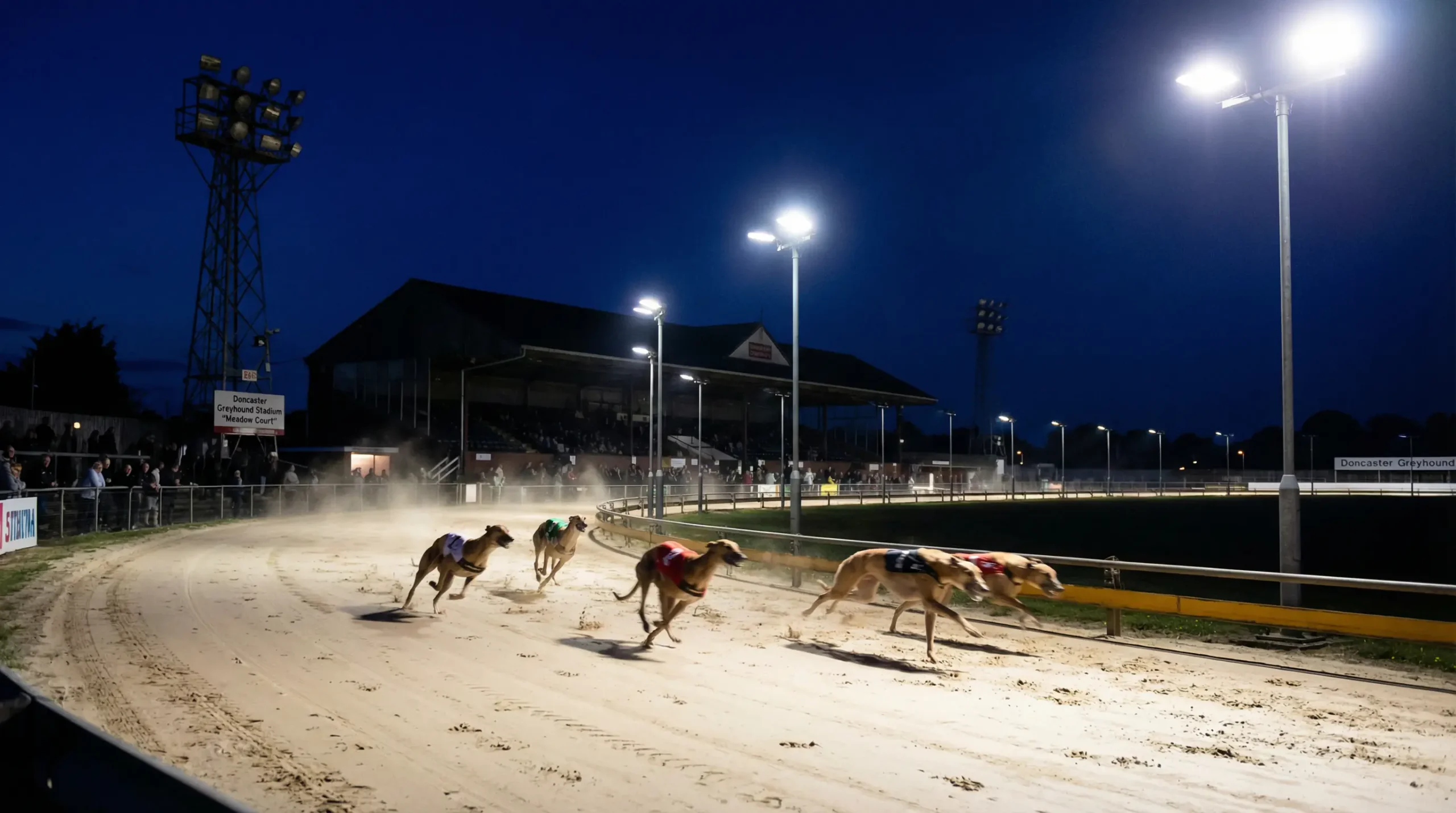
For punters who attend in person, final night is the best evening of racing that Doncaster offers in any given year. The stayers distance showcases the track’s geometry — the long run to the first bend, the sweeping turns, the finishing straight where the crowd noise rises as the dogs approach the line — in a way that sprint and middle-distance races do not. You see the full circumference of the track used, and the longer race duration creates a narrative arc within each race that shorter distances compress into a few breathless seconds.
Whether you are in the grandstand or watching from home, the Yorkshire St Leger is Doncaster greyhound racing at its best. The dogs are the finest distance runners the track can attract, the competition is genuine, and the betting market is rich enough to reward serious form study. For one night in the autumn, Doncaster proves that stayers racing — unhurried, tactical, decided in the final straight — is the most absorbing form of the sport.
