

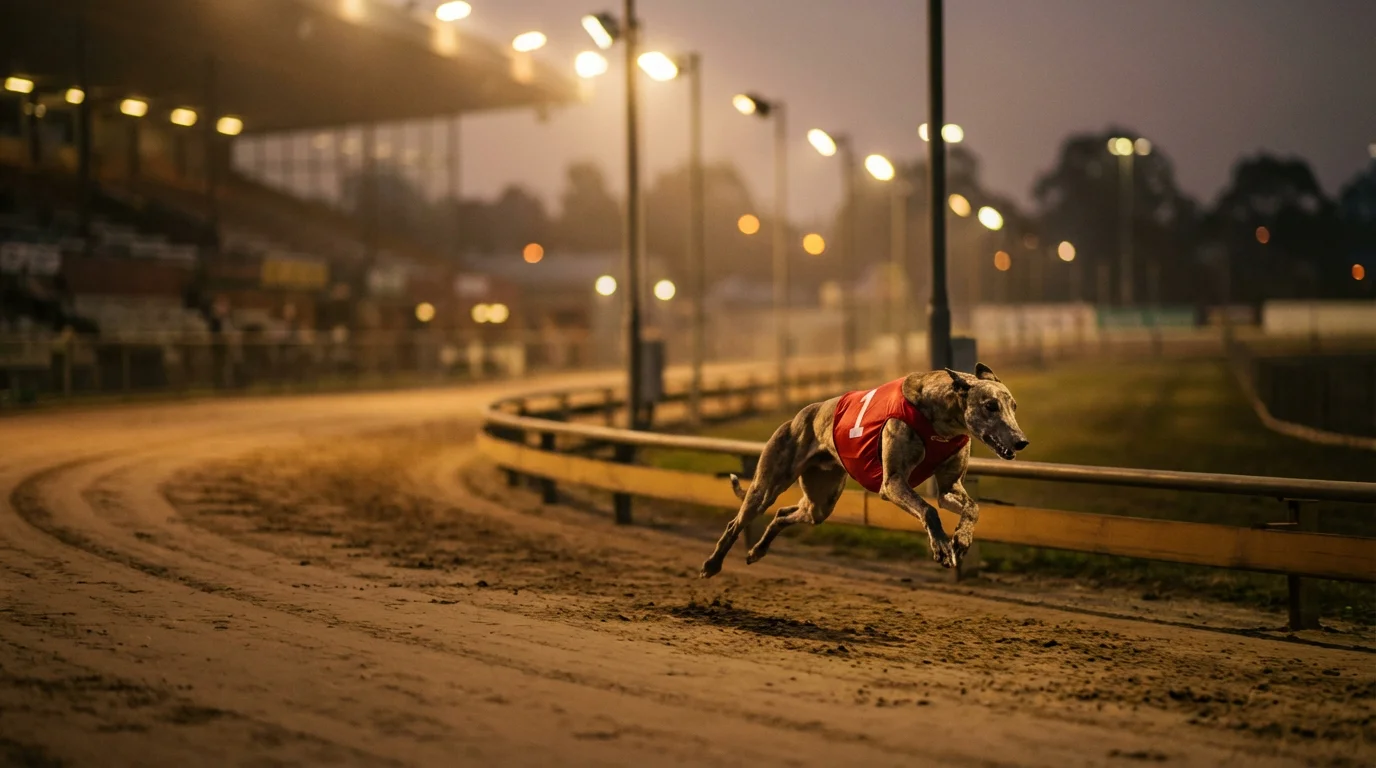
Four Distances, Four Different Sports
A 275-metre sprint and a 705-metre marathon have about as much in common as the 100m and the mile. The dogs are different, the tactics are different, the form indicators that matter are different, and the betting angles change completely depending on which distance is printed at the top of the racecard. Treating all greyhound races as a single discipline is a reliable way to lose money.
Every licensed greyhound track in the UK offers races across a range of distances, though the exact measurements vary by venue. What stays consistent is the classification system: sprint, middle distance, stayers, and marathon. Each category is assigned a letter code on the racecard — D for sprint, A for middle distance, S for stayers — and understanding what each distance demands from a greyhound is foundational to reading form intelligently.
Distance affects everything. The trap draw carries more weight in shorter races where the first bend arrives quickly. Stamina and pacing matter far more over 660 metres than they do over 275. Breeding lines tend to specialise, with certain sires producing offspring that thrive at one distance and struggle at another. And the betting market responds accordingly: sprint races tend to be more volatile, while middle-distance races offer more predictable form patterns.
The grading system itself is built around distance. A dog graded A3 at one track runs middle-distance races at that grade, while a dog graded D2 runs sprints. The letter tells you the distance category, the number tells you the quality. A dog excelling at 480 metres might be entirely ordinary over 275, and a strong stayer can look pedestrian when asked to sprint. Getting this right — matching the dog to the distance — is where competent handicapping begins.
What follows is a breakdown of each distance category, what it demands from the dogs, and what it means for anyone placing a bet. The specific measurements used as examples come from Doncaster Greyhound Stadium, but the principles apply across UK tracks with only minor variation in the exact distances offered.
Sprint Races
Sprint races in UK greyhound racing cover distances under 300 metres. At Doncaster, the sprint distance is 275 metres — roughly two bends and a straight. The entire race is over in around sixteen seconds, which leaves almost no time for a slow starter to recover and almost no room for tactical racing. What you get is raw speed from the traps to the line.
The trap draw is arguably more decisive in sprint races than at any other distance. Because the field reaches the first bend so quickly, a dog breaking fast from an inside trap has an enormous advantage. The run-up to the first bend is the critical window. At Doncaster, that run is 105 metres — generous by UK standards — which gives quick breakers on the inside enough room to establish a lead before the bend compresses the field. At tracks with shorter run-ups, the trap bias can be even more pronounced.
Sprint greyhounds tend to be young, explosive athletes. Their best years are typically between two and three years old, before the edge of their early speed begins to dull. Form over sprint distances is less stable than at middle distance — a dog that clocked a blistering 275-metre time three weeks ago can lose half a length of early pace for reasons that never show up on the racecard. Muscle condition, rest patterns, and even temperament in the traps play a larger role when margins are this thin.
For bettors, sprint races present a paradox. The fields are small and the races are short, which should make outcomes easier to predict. In practice, the opposite is often true. Because early pace is so dominant, a single slow break can ruin a well-fancied dog’s chances. Sectional times are your best tool here — specifically the split time to the first bend. If a dog consistently posts fast splits, it has a structural advantage. If it does not, no amount of raw speed over the full distance will compensate in a race that is essentially decided in the first five seconds.
Forecast and tricast bets can be volatile in sprints. The compressed nature of the race means the first three past the post are often separated by fractions of a length, making exact order predictions risky. Straight win bets on dogs with proven early pace from favourable traps tend to offer the most consistent returns at this distance.
Middle Distance
Middle-distance races cover approximately 450 to 550 metres and represent the core of UK greyhound racing. At Doncaster, the standard middle-distance race is run over 483 metres — four bends and two straights. The majority of graded races at any track fall into this category, and it is where the broadest range of form data is available for analysis.
This is the distance that rewards the most complete greyhound. A dog needs adequate early pace to avoid trouble at the first bend, enough stamina to maintain speed through four bends, and a running style that suits its trap draw. Unlike sprints, where one attribute dominates, middle distance asks for balance. That balance is exactly what makes it the most formful distance in the sport — dogs that perform consistently over 480 metres tend to keep performing consistently, which is a punter’s best friend.
Form reading at middle distance is more reliable precisely because there are more variables in play, and those variables tend to average out over multiple runs. A dog with six recent runs over 480 metres gives you a meaningful dataset: split times, bend positions, finishing positions, calculated times under varying going conditions. You can build a genuine picture of what that greyhound does in a race, how it responds to trouble, and whether it is improving or declining.
The grading system is also at its most refined here. Because the vast majority of races are middle distance, the grades themselves — A1 through A11 or equivalent — are more finely calibrated. A dog dropping from A3 to A4 is meeting slightly weaker opposition, and that shift is meaningful. Spotting a dog that has just been regraded downward after a run of poor luck — crowding, slow breaks from wrong traps — rather than genuine decline is one of the most reliable angles in greyhound betting.
Trap draw still matters, but its influence is diluted compared to sprints. A dog that gets slightly crowded at the first bend has three more bends and two straights to recover. Late-closing types can win middle-distance races in a way that is almost impossible over 275 metres. This makes the betting market more nuanced: you cannot simply back the fastest breaker and expect consistent profits. You need to read the race shape, assess which dogs are likely to get clear runs, and identify where the value lies in the forecast and tricast pools.
Stayers
Stayers races are run over distances between approximately 600 and 700 metres. At Doncaster, the stayers distance is 661 metres — six bends, three straights, and a race that lasts roughly forty seconds. This is where endurance becomes the deciding factor, and the characteristics that define a successful stayer are markedly different from those of a sprint or middle-distance dog.
Experience matters more at stayers distances. Older, more seasoned greyhounds — typically three to five years old — tend to dominate. They have the physical maturity to sustain pace over six bends and the racing intelligence to conserve energy through the early stages before accelerating when it counts. Young dogs with abundant speed but no sense of pacing often lead for the first 400 metres and then fade badly.
Bend positions become more significant as the distance increases. Over six bends, the cumulative effect of running wide or getting checked is amplified. A dog that loses half a length at each bend through poor positioning can find itself three lengths adrift by the home straight with no time to recover — even if it is the faster animal. This is why seeding and running line are critical at stayers distances. A confirmed railer drawn on the inside has a tangible, measurable advantage that goes beyond early pace.
The form of a stayer is often more consistent than that of a sprinter, but the races themselves can produce bigger surprises. Small fields are more common — not every kennel has dogs suited to 660 metres — and the longer distance creates more opportunities for interference, especially through the middle bends where tired dogs begin to drift off their running lines. Calculated times are essential for comparing stayers across different meetings, because the going allowance has a larger absolute effect over longer distances.
For bettors, stayers races often offer genuine value. The general public tends to gravitate toward the more frequent middle-distance and sprint races, leaving the stayers market less scrutinised. Dogs with proven stamina, favourable draws, and trainers who specialise in distance runners can be found at prices that overstate their true chances of losing. If you are willing to develop expertise in a niche distance category, stayers racing repays the effort.
Marathon Races
Marathon races cover distances of 800 metres and above, with some tracks offering races up to 1,100 metres. At Doncaster, the marathon distance is 705 metres. These are rare events on the weekly card — most meetings will include one or two at most, and some cards have none at all.
The scarcity of marathon races creates a small but dedicated niche. Fields are often smaller than at other distances, and the dogs that contest them are specialists. Pedigree becomes a more relevant factor here than at any other distance. Certain sire lines produce offspring with the stamina and muscle composition to sustain effort over eight or more bends, and experienced bettors in this category pay close attention to breeding when a new name appears on the card.
Age is the other key variable. Marathon greyhounds tend to reach their peak later and maintain it longer than sprinters. A four-year-old in marathon races is in its prime. A two-year-old is often too green to manage the tactical demands of a race that can last over fifty seconds. The ability to settle into a rhythm, avoid wasting energy in the early bends, and produce a sustained finish requires a kind of racing maturity that takes time to develop.
Betting on marathon races is a specialist pursuit. The small fields reduce the range of outcomes, which can make forecast dividends lower than you might expect. But the reduced public interest also means that the odds are less efficiently formed, and a punter who knows the marathon form book can find mispriced runners more frequently than in the heavily studied middle-distance grades.
Distance Doesn’t Change — But the Dog Should
The four distance categories are not just labels on a racecard — they are fundamentally different tests of a greyhound’s ability. A sprint dog that gets entered in a stayers race is not simply running further; it is competing in a different sport, against dogs bred and trained for a different purpose.
The most common error punters make with distance is assuming that a fast time over one distance translates to competence at another. It does not. A dog clocking 16.2 seconds over 275 metres might run a perfectly average 30.1 over 483 metres, because the attributes that produce elite sprint speed — explosive trap exit, rapid acceleration, raw pace — are not the same attributes that produce elite middle-distance performance, where sustained speed, bend technique, and the ability to travel through a field matter more.
When you see a dog switching distances on the racecard, treat it as a new proposition. Its previous form at the old distance is context, not evidence. Look at its breeding for clues about whether it might suit the new trip. Check whether the trainer has a pattern of switching dogs at this stage of their careers. And adjust your staking accordingly — a dog trying a new distance is, by definition, less predictable than one with ten runs at the same trip.
The distance printed at the top of the racecard is the first thing you should read and the last thing you should ignore. Build your approach around it, and the rest of the form starts to make a lot more sense.
