

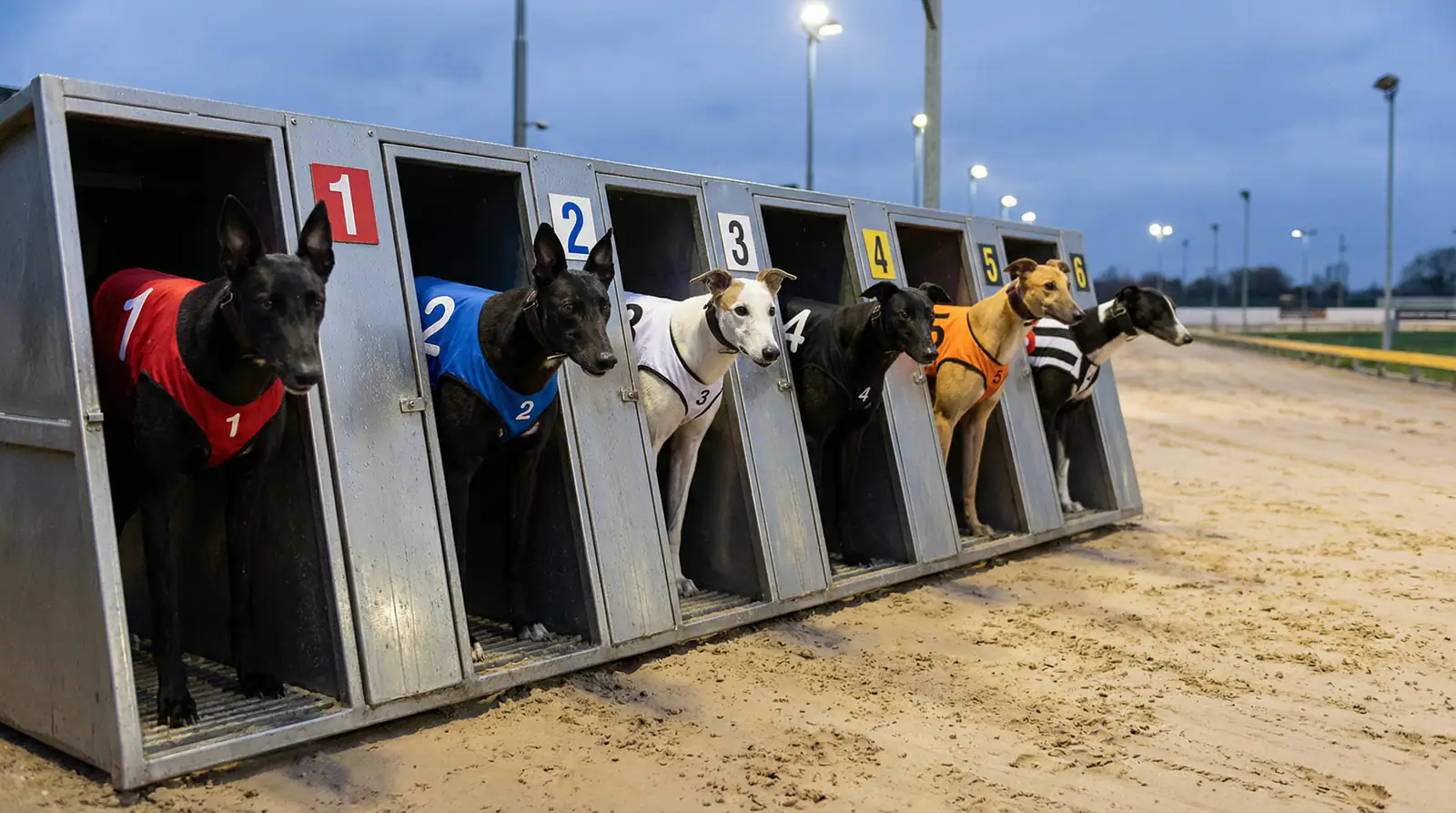
What Greyhound Grades Mean
The grading system is how UK greyhound racing sorts dogs into competitive brackets. Its purpose is simple: ensure that greyhounds of similar ability race against each other, so races are competitive and betting markets are meaningful. Without grades, a top-class open-race dog would be running against animals several lengths slower, and nobody — punter, trainer, or spectator — benefits from a procession.
Each grade is expressed as a letter-number combination. The letter indicates the distance category — A for middle distance, D for sprints, S for stayers — and the number indicates the quality tier within that category. A1 is the highest graded middle-distance class at a given track, while A9 or A10 sits at the bottom. The lower the number, the faster the dogs. A greyhound graded A3 is expected to be quicker and more competitive than one graded A6, and the races it enters will be populated by dogs of corresponding ability.
Grades are track-specific. This is one of the most important things to understand, and one of the most frequently misunderstood. An A1 greyhound at Doncaster is not necessarily the same standard as an A1 at Romford or Nottingham. Larger, more prominent tracks tend to attract higher-quality dogs, so their top grades are stronger. A dog graded A3 at a track with deep competition might comfortably win at A1 level at a smaller venue. This is why watching for dogs transferring between tracks — and the grade they are assigned at the new venue — can produce immediate betting opportunities.
The Greyhound Board of Great Britain oversees the sport at licensed tracks, but the day-to-day grading decisions are made by individual racing managers at each stadium. These managers assess each dog’s recent performances and assign grades accordingly. It is a human process, not an algorithm, and that subjectivity creates the occasional inefficiency that alert punters can exploit.
There is no universal grading scale that spans all tracks. Two dogs rated A4 at different venues might be separated by several lengths in actual ability. For bettors, this means that grades are a guide to relative ability within a single track, not an absolute measure of quality. Treat them as context, not gospel.
How Dogs Move Between Grades
Greyhound grades are not static. Dogs move up when they win or perform consistently well, and they move down when they lose or underperform. The racing manager at each track makes these decisions after reviewing recent results, typically considering the last three to six runs.
A dog that wins an A5 race might be raised to A4 for its next outing. If it then finishes poorly in two or three A4 races, it could drop back to A5. The speed of these transitions varies — some tracks regrade dogs more aggressively than others, and some racing managers are more conservative. There is no fixed rule that says “two wins equals promotion.” It is a judgment call, and the racing manager will consider not just results but also winning times, margins, and the quality of opposition.
This fluidity is the single most useful feature of the grading system for bettors. A dog that was recently promoted after a string of wins is now facing stronger opposition, and the market sometimes underestimates how significant that step up is. Conversely, a dog dropping a grade after two unlucky runs — checked at the first bend, crowded on the back straight — may be facing easier opposition while still being just as fast as it was three weeks ago. The form is the same; only the grade has changed.
Dogs that are new to a track receive an initial grading based on their trial times and any form from their previous venue. This is where the sharpest bettors find some of their best opportunities. A greyhound transferring from a strong track like Nottingham to a smaller venue might be given a grade that underestimates its actual ability, because the racing manager at the new track is working with limited information. First-time runners at a new venue deserve extra attention.
Promotion and demotion also create patterns. A dog that oscillates between two grades over several months — winning at the lower level, struggling at the higher one — is telling you exactly where its ceiling is. That information is more valuable than any tip.
Grade Letters and Distance Codes
The letter prefix in a greyhound’s grade tells you the distance category of the race. This coding system is standard across UK licensed tracks, though the specific distances each letter covers vary slightly by venue.
The primary codes are: D for sprint distances, typically under 300 metres. A for middle distance, the most common category, covering roughly 450 to 550 metres. S for stayers, usually 600 to 700 metres. H appears on the racecard for hurdle races, though these are now extremely rare at UK tracks. Some venues also use M for marathon distances over 700 metres, and there are additional codes for specialist race types.
A full grade code reads like this: A3 means middle distance, grade three. D1 means sprint, grade one — the fastest sprint dogs at that track. S5 means stayers, grade five. The code tells you immediately what kind of race you are looking at and where the field sits in the quality hierarchy.
Beyond the standard grading letters, you will encounter additional codes on racecards that indicate the race type rather than the grade. OR designates an open race, which sits outside the grading ladder entirely. P indicates a puppy race, restricted to dogs under a certain age. N marks a novice race for dogs with limited racing experience. HP or Hcp signals a handicap race. Each of these codes tells you something about the composition of the field and the conditions of the race, which in turn affects how you should assess form.
Understanding these codes is not optional. A dog’s grade code is the first piece of information on the racecard, and it frames everything that follows. If you are comparing two dogs and one is graded A3 while the other is graded S3, you are not comparing like with like — they race at different distances, and their grades reflect different competitive environments.
Open Races: OR1, OR2, OR3
Open races sit above the grading system entirely. They are the highest level of competition in UK greyhound racing, drawing the best dogs from across the country. The grading system’s purpose is to separate dogs of different abilities, but open races exist for the opposite reason — to bring the best together.
Open races are classified into three categories. OR1, or Category One, represents the elite tier. These are the races that make up the sport’s showcase events: the English Greyhound Derby, the St Leger, the Oaks, and other prestigious competitions backed by Premier Greyhound Racing. There are roughly sixty Category One events staged each year across UK tracks, and they attract the highest calibre of greyhound. Category Two events, designated OR2, sit one rung below. They carry significant prize money and prestige but do not quite reach the level of OR1 competitions. Category Three events and one-off open races, marked as OR3 or simply OR, complete the hierarchy.
Entry to open races is not based on grades. Instead, trainers enter their dogs based on ability and recent form, and the racing manager selects the field. This means you will see dogs from different tracks and different grading levels competing against each other, which makes form comparison more complex. A dog graded A1 at one track might be up against an A2 dog from a track with stronger overall competition, and the grades alone will not tell you which is the better animal.
For bettors, open races require a different approach. The form book is thinner because the dogs do not race against each other regularly, the fields are drawn from a wider pool, and the competitive standard is higher and less predictable. Ante-post betting on major open-race competitions — the Derby, the St Leger — carries additional risk because entries are large and not all entrants will make it to the final. But the rewards for getting it right can be substantial, and the prestige events attract enough public money to occasionally push favourites below their true price, creating value elsewhere in the market.
Many dogs that compete in open races also run in top-level graded races at their home track. Watching how an OR-class dog performs when returning to graded company can be instructive. If it wins a graded race easily after competing in an open event, the graded competition may simply be too weak for it — and backing it at short odds in that context is dead money. But if it struggles, the open race may have exposed a ceiling in its ability that the graded form did not reveal.
Grading as a Betting Tool
The grading system is not a handicapping tool on its own, but it becomes one when you understand how to read the movements within it. The grade tells you the context of a dog’s recent form. The movement between grades tells you the trajectory.
A dog dropping in grade is not automatically a good bet. Sometimes the drop reflects genuine decline — age, injury recovery, loss of early pace. But when the drop is caused by circumstances rather than ability — a series of poor draws, crowding in running, a spell at a tougher track — the newly graded dog is essentially the same animal facing weaker opposition. That is the definition of a betting opportunity.
The reverse applies too. A dog that has been promoted after two flashy wins might be facing stiffer competition than it has ever encountered. If the wins came from favourable draws and weak fields, the market price at the new grade may be far too short. Grade promotions test a dog’s true level, and many fail that test.
Track transfers deserve particular scrutiny. When a dog moves from one track to another, the racing manager at the new venue has to assign a grade based on limited evidence. Sometimes the initial grade is too generous, and the dog gets beaten easily. Other times it is too conservative, and a dog wins its first outing at the new track by a wide margin. If you can identify which scenario is more likely — by comparing the dog’s times at its old track to the standard times at its new venue — you have an edge that most casual bettors lack.
Grades are the skeleton of greyhound racing. They give the sport structure and the racecard meaning. But the real value for punters lies not in what a grade is, but in what it is about to become. Every regrading decision is a signal. Learning to read those signals is one of the quieter, more profitable skills in the sport.
