

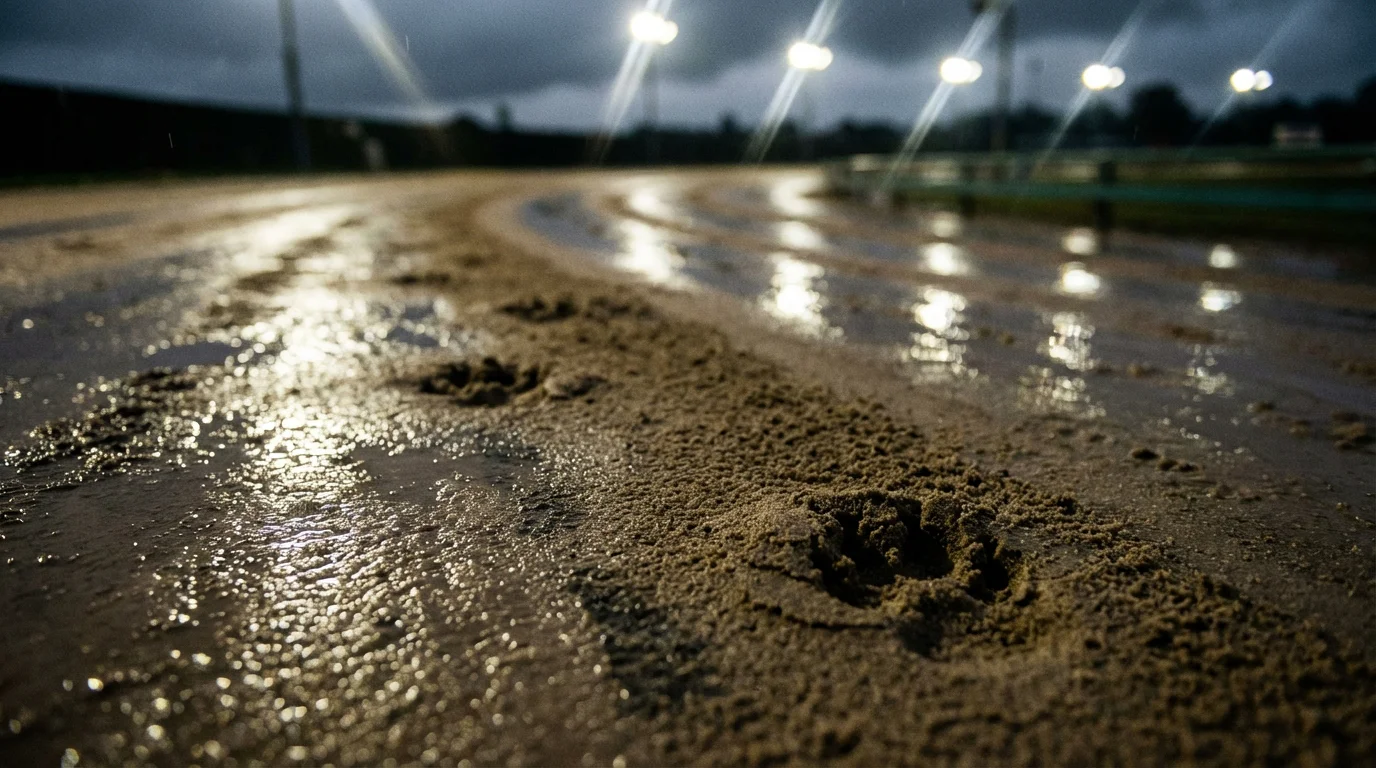
How Track Conditions Affect Greyhound Times
Every greyhound race takes place on a surface, and that surface is never the same twice. UK greyhound tracks use sand-based surfaces that respond to moisture, temperature, and wear in ways that directly affect running times. A dog that clocks 29.50 seconds over 480 metres on a dry, fast surface might record 30.10 over the same distance when the track is wet and holding. The dog has not become slower overnight. The ground has.
Track conditions in greyhound racing are described using a going scale, similar in principle to the going descriptions used in horse racing. The terminology varies slightly between tracks, but the general framework runs from fast through normal to slow, with intermediate descriptions for conditions that fall between these benchmarks. A fast track is dry, firm, and offers minimal resistance — dogs post their quickest times. A slow track is wet, heavy, and saps energy — times lengthen, and stamina becomes more important than pure speed.
The impact on times is not uniform across all dogs. Some greyhounds handle heavy going better than others, just as some racehorses are described as mudlarks. The reasons are partly physical — certain body types cope better with soft, energy-sapping surfaces — and partly related to running style. Dogs that rely on explosive early pace tend to lose more on a slow track than dogs that run consistently through the race, because the resistance of the surface blunts the initial acceleration that a front-runner depends on.
For bettors, the critical point is that raw times are only meaningful when interpreted in the context of the going. A 29.80 on a slow track might represent a better performance than a 29.50 on a fast track. Comparing times without adjusting for conditions is like comparing cricket batting averages without accounting for the pitches played on — the numbers look precise, but they are misleading. This is where the going allowance system becomes essential.
The going is assessed before every meeting and can change during the course of a card if weather conditions shift. A meeting that starts on normal going might shift to slow going after two hours of rain. The going report is published alongside the racecard and is one of the first things a serious punter should check before studying the form. It frames everything that follows.
The Going Allowance System
The going allowance is a numerical adjustment applied to each dog’s actual running time to produce a calculated time that accounts for the track conditions on the day. It is the mechanism that allows meaningful comparison of performances across different meetings, different weather conditions, and different surface states.
The allowance is expressed in hundredths of a second and is added to or subtracted from the actual running time depending on whether the track is faster or slower than the benchmark standard. If the going allowance for a meeting is +20, the track is running slow, and twenty hundredths of a second are subtracted from each dog’s time to produce the calculated time. If the allowance is -10, the track is fast, and ten hundredths are added. The result is a standardised time that theoretically represents what the dog would have run on a normal surface.
This calculated time — often abbreviated to CalcTm on racecards and results — is one of the most valuable figures in greyhound form analysis. It strips out the variable of surface condition and lets you compare a dog’s performance in January rain with its performance on a dry July evening. Without this adjustment, any form analysis based on times would be fundamentally flawed, because you would be conflating the dog’s ability with the state of the ground beneath it.
The going allowance is determined by the racing manager at each meeting, typically by running a trial dog over a set distance before racing begins and comparing the trial time against a known standard. This process is imperfect — the trial dog may not run consistently, and the track surface may not be uniform across its entire circumference — but it provides a workable approximation that is far more useful than no adjustment at all.
Different tracks calculate and apply the going allowance in slightly different ways, and some punters find the adjustments at certain venues more reliable than others. Over time, you develop a feel for which tracks produce calculated times that genuinely reflect underlying ability and which produce figures that need additional interpretation. Trusting the CalcTm blindly is a mistake, but ignoring it is a bigger one.
Weather, Sand, and Seasonal Patterns
UK greyhound racing runs year-round, which means the tracks experience the full range of British weather. The effect on racing surfaces is significant and follows seasonal patterns that experienced punters learn to anticipate.
Winter meetings tend to produce slower going. Rain is more frequent, temperatures are lower, and the sand holds moisture longer. Evening meetings in December and January regularly record going allowances in the +15 to +30 range, meaning times are materially affected. Dogs that thrive in these conditions — those with stamina, physical strength, and a running style that does not depend on blistering early pace — gain a genuine advantage during the winter months.
Summer is the opposite. Dry, warm conditions produce fast tracks where the surface is firm and drainage is not a factor. Going allowances often sit at zero or move into negative territory, and the fastest times of the year are recorded in June, July, and August. Sprint dogs and early-pace specialists tend to perform at their best when the surface is fast, because the firmness of the ground translates directly into more efficient acceleration out of the traps.
The transitional months — March, April, September, October — produce the most variable conditions. A meeting might start on normal going and shift to slow within two hours as an unexpected rain shower passes through. These are the meetings where the going allowance needs to be reassessed race by race, and where the published going report from before the first race may not accurately reflect conditions for the seventh or eighth race on the card.
Sand quality also matters. Tracks resurface their sand periodically, and freshly laid sand behaves differently from worn, compacted material. After a resurfacing, times can shift unpredictably for several meetings as the new sand settles. Punters who track a specific venue closely will notice these periods and adjust their expectations accordingly. A dog posting seemingly poor times in the weeks after a resurfacing may not have declined — the surface may simply be in a transitional state.
Wind is the overlooked variable. A strong headwind on the home straight adds time; a tailwind subtracts it. Unlike rain, wind is not reflected in the going allowance, which means the calculated time on a windy night may still contain a hidden variable. There is no practical way to adjust for wind from the racecard alone, but if you are watching a meeting live and notice that times in the first few races are consistently above or below expectations, wind may be the explanation.
Dogs That Handle Heavy Going
Not every greyhound is equally affected by a slow surface. Identifying dogs that maintain their form when conditions deteriorate is a practical skill that produces betting opportunities, because the market often overreacts to slow going by backing the same favourites regardless of their suitability to the conditions.
Dogs that handle heavy going tend to share certain characteristics. They are often physically strong, with a muscular build that powers through surface resistance rather than skimming over the top. They tend to be middle-distance or stayers specialists rather than pure sprinters, because sustained effort is more important than initial acceleration when the ground is demanding. And they frequently have a running style that emphasises consistency over explosive pace — the kind of dog that runs every section of the race at a similar tempo rather than blazing through the first two bends and fading.
Form on heavy going is the best predictor of future form on heavy going. This sounds obvious, but many punters overlook it. A dog with three runs on slow going that produced a win and two seconds is telling you something unambiguous about its suitability to the conditions. A dog with ten runs on fast going and no experience of slow conditions is an unknown quantity, and unknowns are risky bets regardless of how impressive their dry-weather form looks.
Trainers who regularly campaign at a particular track develop an understanding of which dogs in their kennel handle the heavier conditions. Some trainers withdraw dogs when the going turns against them and enter them on drier nights. Others persevere regardless. Noticing these patterns — which trainers protect their dogs from unsuitable going and which do not — is useful context for assessing the likely performance of a dog on a wet card.
At the betting level, heavy going meetings often produce longer-priced winners. The public tends to back dogs based on their most recent form, which was typically achieved on faster ground. When conditions change, those form lines become less reliable, and the dogs best suited to the slower surface may be sitting at 5/1 or 6/1 instead of the 2/1 they would be if the market properly accounted for going preferences. Finding those mispriced runners on a wet night is one of the more consistent edges available in greyhound betting.
Conditions Change — Your Approach Should Too
The going is not static, and your method of reading form should not be either. A punter who uses the same assessment process on a fast July evening and a sodden January night is applying the wrong tool to one of those jobs.
On fast going, prioritise early pace and trap draw. The surface rewards speed, the first bend is reached quickly, and dogs that get to the front tend to stay there. Calculated times are at their most reliable because the going allowance is small and the margin for error in the adjustment is narrow.
On slow going, shift your emphasis toward stamina, running style, and proven form on heavy ground. The trap draw matters less because the slower surface gives dogs more time to sort themselves out before the bend. Late-closing types have a better chance of making up ground, because the leaders fatigue earlier. And calculated times should be treated with more caution, because a large going allowance introduces more uncertainty into the adjustment.
Check the going before you study the form. Let the conditions frame your analysis rather than treating them as an afterthought. The best dogs on the card are not always the best bets on the card — sometimes the conditions promote a different kind of runner entirely.
