

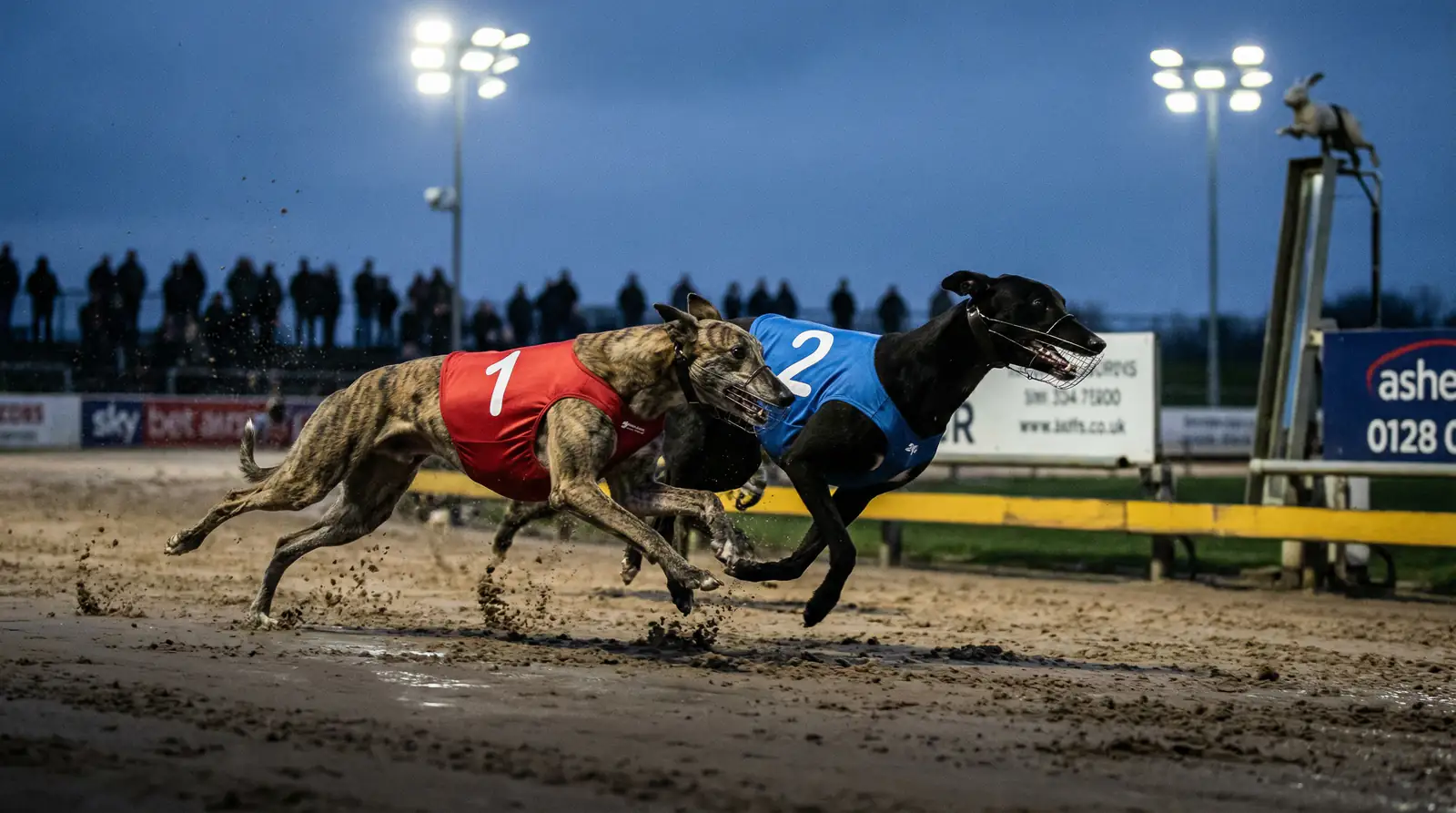
What Is a Forecast Bet?
A forecast bet requires you to predict which dogs will finish first and second in a greyhound race. Unlike a simple win bet, where you only need one dog to cross the line first, a forecast demands that you get two selections right — and in the case of a straight forecast, in the exact order. The reward for that additional difficulty is a dividend that can be substantially larger than anything a single win bet produces.
Forecast betting is particularly well suited to greyhound racing for a structural reason: there are only six runners. In horse racing, where fields of twelve, sixteen, or even twenty runners are common, predicting the first two home is a formidable task. In a six-dog greyhound race, the number of possible first-and-second combinations is thirty — still challenging, but within the range where careful form analysis can produce consistent results. This is why forecast betting is more popular among greyhound punters than in almost any other racing discipline.
There are three types of forecast bet: straight forecast, reverse forecast, and combination forecast. Each asks a different question, carries a different cost, and offers a different risk-reward profile. Understanding the distinctions is not optional for anyone who takes greyhound betting seriously — forecast bets are where informed punters often generate their best returns.
Forecasts in UK greyhound racing are typically pool-based bets, meaning the dividend is determined by the total amount staked on the forecast pool for that race and how many winning tickets there are. The more people who correctly predicted the first two, the smaller the payout. This pool structure means that forecast dividends are not fixed odds — they fluctuate based on public betting patterns, which creates opportunities for punters who identify outcomes the market has undervalued.
Straight vs Reverse vs Combination
A straight forecast is a single bet that names the first and second finishers in exact order. You are saying: Trap 3 will win and Trap 5 will finish second. If Trap 5 wins and Trap 3 finishes second, you lose. The order is everything. This is the highest-risk, highest-reward form of forecast betting, and it requires genuine conviction about how a race will unfold.
The payout for a straight forecast reflects that difficulty. Because only one specific outcome from thirty possible combinations satisfies the bet, the dividends can be significant. A straight forecast involving two mid-priced dogs might return £20 to £50 for a £1 stake, depending on the pool. When both dogs are outsiders, the dividend can run into hundreds. The key is that you are not just identifying the two best dogs — you are predicting which one beats the other, which requires understanding of early pace, draw, and running style dynamics between the two selections.
A reverse forecast covers both possible orders of your two selections. If you nominate Trap 3 and Trap 5, you win whether Trap 3 wins with Trap 5 second, or Trap 5 wins with Trap 3 second. This is effectively two straight forecasts in one transaction, so the stake is doubled. A £1 reverse forecast costs £2. The payout is the straight forecast dividend for whichever order actually occurs.
The reverse forecast is the most commonly used forecast bet among regular punters, and for good reason. In many races, you can identify the two dogs most likely to fill the first two positions without being confident which one will beat the other. Maybe both have strong early pace and are drawn on the same side of the track. Maybe one has the better calculated time but the other has the better draw. Rather than guessing the order, the reverse forecast lets you back your analysis of the top two without requiring precision about which is marginally faster on the day.
A combination forecast extends this logic further. Instead of two selections, you nominate three or more dogs and cover all possible first-and-second permutations. A combination forecast on three dogs (Traps 1, 3, and 5) covers six possible outcomes: 1-3, 1-5, 3-1, 3-5, 5-1, 5-3. The cost is six times the unit stake. For four dogs, it is twelve permutations. The coverage is broad, but the cost escalates quickly, and the dividend from a combination forecast needs to be large enough to justify the multi-unit stake.
Combination forecasts are best used in races where you can confidently eliminate two or three dogs from contention but cannot separate the remaining three. They are a poor choice in wide-open races where all six dogs have a realistic chance, because the number of permutations makes the bet expensive relative to the likely dividend.
How Forecast Dividends Are Calculated
In UK greyhound racing, forecast dividends are primarily determined through the tote pool system. The total amount staked on the forecast pool for a given race is collected, the operator takes a percentage (the takeout), and the remainder is divided among the winning tickets. The more popular the winning combination was with bettors, the lower the dividend. The less popular it was, the higher the payout.
This pool-based system means that forecast dividends are not knowable in advance. You cannot look at the odds board before a race and calculate exactly what a correct forecast will pay. The dividend is revealed after the race, once all bets have been settled. This uncertainty is part of what makes forecast betting compelling — and part of what makes it risky.
What you can estimate, however, is the likely range. Forecast dividends tend to correlate loosely with the win odds of the two placed dogs. If both dogs were short-priced favourites, the dividend will be modest — perhaps £5 to £15 for a £1 stake — because many bettors will have backed the obvious combination. If one or both dogs are outsiders, the dividend rises sharply because fewer bettors will have predicted that combination.
The computer straight forecast, or CSF, is an alternative offered by some bookmakers. Instead of paying a pool-based dividend, the bookmaker calculates a theoretical fair price for the forecast based on the starting prices of the two dogs. The CSF tends to produce slightly lower payouts than the tote in races where the result is surprising, and slightly higher payouts when the result is predictable. Over a large number of bets, the differences are marginal, but individual races can show significant variance between the tote dividend and the CSF return.
For bettors seeking the best return, checking whether the tote or the CSF offers better value for a particular race is worthwhile when both options are available. In practice, most online bookmakers default to the CSF for greyhound forecasts, while track-based betting typically uses the tote pool.
Finding Forecast-Friendly Races
Not every race is suited to forecast betting. The best forecast opportunities share a common characteristic: a field where two or three dogs stand out clearly from the rest, but where the outcome between those top dogs is genuinely uncertain.
Tightly graded races where all six dogs have similar form are poor forecast propositions. When any combination of first and second is plausible, forecasting becomes closer to gambling than handicapping, and the dividends for common outcomes will not compensate for the frequency of losing bets. You want races with separation — two or three dogs that are clearly better than the rest, but close enough to each other that predicting the order requires analysis.
Look for races where the form points to two contenders with different strengths. One dog with superior early pace but a less favourable draw. Another with the best calculated time but a tendency to start slowly. These contrasting profiles create a genuine two-way market within the race: if the fast breaker clears the first bend, it wins. If it does not, the other dog runs it down. A reverse forecast on these two captures both scenarios.
Grade drops are another fertile ground. When a dog recently demoted to a lower grade enters a race against weaker opposition, it is often a strong forecast candidate for the first position. The question then becomes which of the remaining five dogs is most likely to finish second. If one of those five has been running close seconds at this grade consistently, you have a logical forecast selection at a reasonable cost.
Avoid forecast betting in races with high interference potential. When the seeding is poor — railers drawn outside, wide runners drawn inside — the first bend is likely to be messy, and the resulting chaos makes any positional prediction unreliable. Forecasts reward clean, formful races. Save them for the right opportunities.
The Forecast Punter’s Playbook
Forecast betting is a skill that improves with practice and discipline. The starting point is simple: never place a forecast bet in a race you have not analysed thoroughly. A forecast based on a hunch or a name you like is not betting strategy — it is a lottery ticket.
Build your approach around the reverse forecast as your primary weapon. In most graded races, identifying the two best dogs is achievable through form analysis; predicting which one edges the other is often a coin flip determined by the break from the traps. The reverse forecast lets you capitalise on your analytical ability without requiring luck on the precision.
Track your forecast betting separately from your win bets. The strike rate will be lower — you need two predictions to be correct, not one — but the average return per winning bet should be higher. Over time, the profit-and-loss picture from forecast betting should tell you whether your ability to identify the top two dogs is genuine or whether you are paying too much for the privilege of being roughly right.
And be selective. The temptation with forecast betting is to have a forecast on every race, because the potential returns are enticing. Resist that temptation. The best forecast bettors are the ones who wait for the right race, back their analysis with appropriate stakes, and accept the higher variance that comes with a bet that demands two correct predictions instead of one.
