

How Starting Price Is Set in Greyhound Racing
The starting price — universally abbreviated to SP — is the official odds of a greyhound at the moment the traps open. It is the price that determines payouts for bettors who did not take a fixed price in advance, and it serves as the benchmark against which all other prices are measured. Understanding how the SP is formed is fundamental to making informed decisions about when to take a price and when to wait.
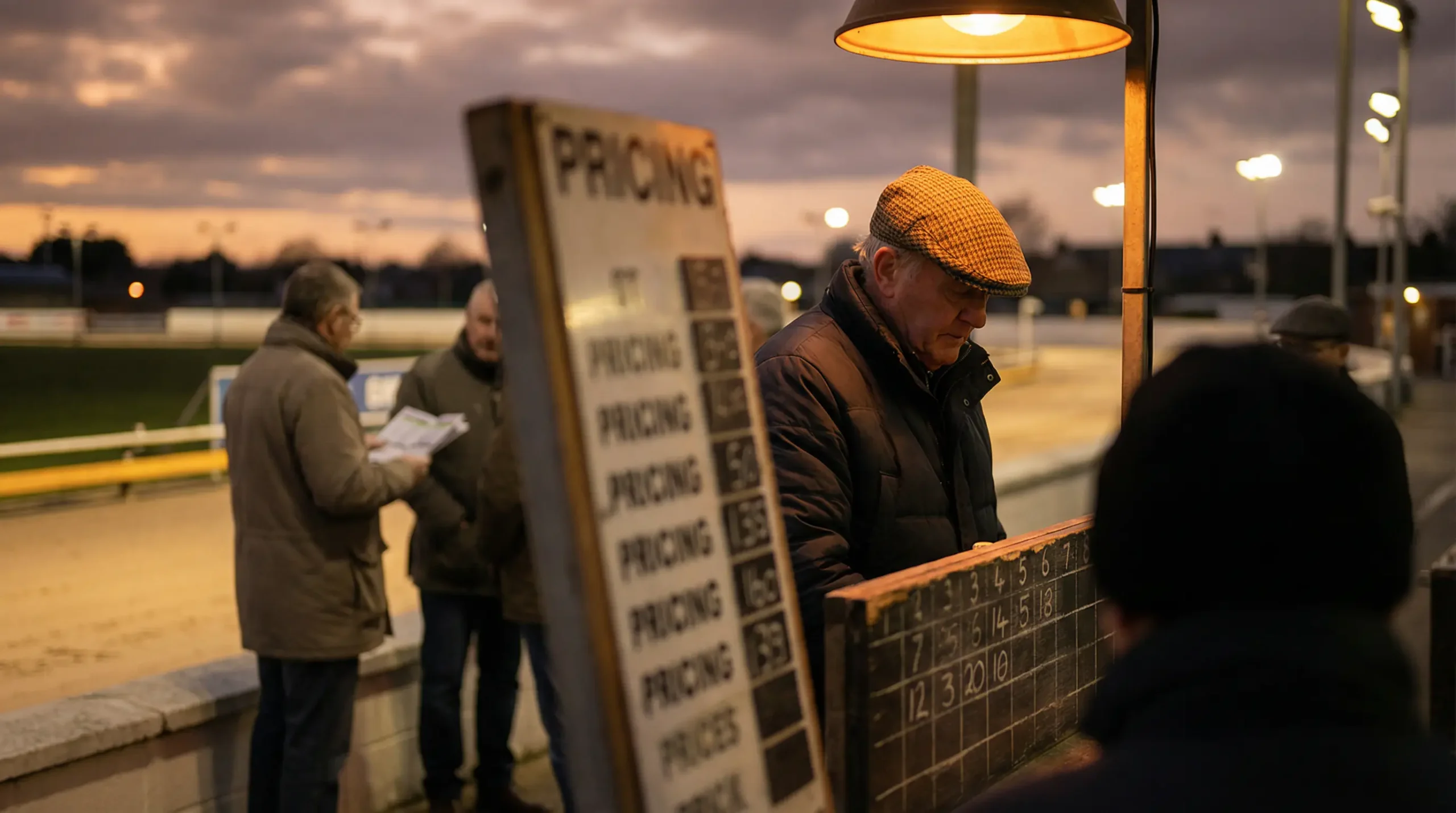
In UK greyhound racing, the SP is derived from the on-course betting market. At every licensed meeting, on-course bookmakers display odds boards showing the prices they are willing to offer on each runner. These odds move in response to betting activity — money coming in for a particular dog will shorten its price, while a lack of interest will see the price drift. An official SP reporter, independent of the bookmakers, records the prevailing prices just before the race starts and determines the SP for each runner based on the best available prices from the on-course ring.
The process is similar to horse racing, but with some practical differences. Greyhound meetings typically have smaller on-course betting rings, sometimes with fewer bookmakers displaying boards. This can make the on-course market thinner and more volatile, meaning that a relatively small amount of money can move the price significantly. A single substantial bet on a dog in a small betting ring can shorten its SP from 5/1 to 3/1, which would require a much larger sum at a major horse racing meeting.
At meetings broadcast through BAGS (Bookmakers’ Afternoon Greyhound Service) and SIS, the SP formation includes input from the off-course market as well. Betting exchanges and the large volumes wagered through online bookmakers feed into the overall price picture, though the official SP is still recorded from the on-course market. This dual input means that SP at major broadcast meetings tends to be more reflective of genuine market sentiment than at small independent meetings where the on-course ring may consist of just two or three bookmakers.
The SP is determined just before the traps open — not minutes before, but seconds before. This is a critical distinction. Prices can move right up until the off, and the SP you see recorded in the results may differ from the price that was showing on the boards two minutes earlier. For bettors watching the market in real time, this means the final SP is a snapshot of a moving target, not a stable figure.
SP vs Early Price: When to Take What
The decision between taking an early fixed price and betting at SP is one of the most consequential tactical choices in greyhound betting. Each option has advantages, and the right choice depends on your assessment of how the market is likely to move between now and race time.
Taking an early price locks in your odds. If you back a dog at 4/1 at 10am and the SP comes in at 2/1, you still get paid at 4/1 — a significant advantage. If you have Best Odds Guaranteed, you also benefit if the SP drifts above your early price. The early price option rewards bettors who can identify value before the broader market has fully formed, and it protects against the common scenario where a well-fancied dog is backed down to a shorter price by the public closer to race time.
Betting at SP, on the other hand, means you accept whatever price the market produces at the off. The advantage of SP is that you do not commit to a price that might prove to be poor value if circumstances change. A dog that looked strong in the morning might have a poor trial, show up at the track underweight, or draw unfavourably in a reserve runner scenario. By waiting until SP, you capture any price drift that reflects negative information entering the market.
In practice, the decision depends on your typical betting pattern. If you place your bets in the morning based on the racecard and do not follow the market throughout the day, taking the early price — preferably with a BOG bookmaker — is almost always the better choice. You lock in your odds and are protected from shortening, while BOG covers the scenario where the price drifts in your favour.
If you are an active bettor who monitors price movements and can assess whether early-morning odds represent value or are likely to contract, waiting can be advantageous. Some punters deliberately wait until closer to race time to see how the market reacts to the card, betting only when they spot a price that they believe is too long relative to their own assessment. This approach requires discipline and real-time access to odds, but it can capture value that early-morning bettors miss.
A hybrid approach works well for many greyhound punters: take the early price when it represents clear value (your assessment suggests the dog is shorter than the price implies), and bet at SP or close to post time when the early price appears fair or slightly short. The goal in every scenario is the same — to bet at the highest price that reflects genuine value given your analysis.
On-Course Market Makers and SP Formation
The on-course bookmakers who set the prices at a greyhound meeting are central to the SP formation process. They are independent operators who make their own books, and their combined activity creates the market from which the SP is derived. Understanding how they operate gives you insight into what the SP actually represents and where its limitations lie.
On-course bookmakers set their initial prices based on the racecard information — form, trap draw, trainer, and their own assessment of the likely betting patterns. These opening prices are displayed on boards around the betting ring, and they immediately begin to move as punters place bets. A rush of money for one dog will shorten its price, while neglect of another will see its odds drift.
At larger greyhound meetings — Saturday evenings at Romford, or a featured event at Nottingham — the betting ring may have half a dozen or more bookmakers competing for business. This competition tends to produce a more efficient market, where the prices on offer closely reflect the true probabilities implied by the total weight of money. At smaller meetings, where only two or three bookmakers operate, the market is thinner and the prices are more susceptible to manipulation by large individual bets.
The SP reporter’s job is to assess the overall market at the moment the traps open and record a representative price for each runner. This is a judgment call — different bookmakers may be showing slightly different prices, and the reporter must determine the prevailing market price. In practice, the SP reporter typically records the most commonly available price at the time of the off, with priority given to the prices of bookmakers who have the largest books (the most money staked with them).
For bettors, the practical implication is that the SP at a large, well-attended meeting is a more reliable reflection of a dog’s true chances than the SP at a sparsely attended afternoon meeting. If you are using SP as your benchmark for assessing whether your early price represented value, be aware that the quality of the SP itself varies with the depth and competitiveness of the on-course market.
The tote is an alternative to the SP-based bookmaker market. Tote odds are determined by the pool of bets placed through the tote system, and the returns can differ significantly from the bookmaker SP. At some meetings, the tote returns exceed the bookmaker SP; at others, they fall short. Experienced punters compare both before deciding where to place their money, though in practice most off-course betting is settled at either fixed odds or SP through bookmakers rather than through the tote.
SP Favourites: How Often Do They Win?
The SP favourite is the dog with the shortest starting price in a race — the one the market collectively deems most likely to win. Tracking the performance of SP favourites is one of the simplest ways to understand how efficient the greyhound betting market is and what that efficiency means for your approach.
Across UK greyhound racing, SP favourites win approximately 30 to 35 percent of races. This figure varies by track, distance, and race type, but the range is remarkably consistent. In well-graded middle-distance races, where the form is most reliable, the favourite’s win rate tends to sit at the higher end. In sprints, where a single bad break can undo the best dog in the field, the rate is lower. In open races with less predictable form, it drops further still.
A 30 to 35 percent win rate means that the favourite loses roughly two out of every three races. This is a critical fact for punters who default to backing the market leader. Favourites at typical SP prices of 6/4 to 2/1 need to win around 40 percent of the time to produce a flat-stake profit. Since they win only 30 to 35 percent, blind favourite-backing is a guaranteed long-term loss.
That said, favourites are not wrong — they are just not right often enough at the prices offered. The dog the market identifies as most likely to win is, in fact, the most likely to win. The problem is price, not prediction. If the favourite’s true probability of winning is 33 percent but the SP implies a 40 percent chance (odds of around 6/4), the bet is poor value despite the dog being the best in the race.
For bettors, the takeaway is not to avoid favourites entirely, but to assess whether the price on offer reflects genuine value given the specific race conditions. A favourite at 5/2 in a race where your own analysis suggests it has a 40 to 45 percent chance of winning is a value bet. The same dog at evens in the same race is not, even though it is still the most likely winner. The SP tells you what the market thinks. It does not tell you what the market should think.
Reading the Market Before the Traps Open
The greyhound market is a conversation, and the starting price is the final word. But everything said before that final word — the opening prices, the movements, the drift, the shortening — contains information that an attentive punter can use.
A dog that opens at 4/1 and is backed down to 2/1 by post time is receiving market support. The money coming in for that dog represents the collective judgment of punters — including, potentially, well-informed insiders — that it has a better chance of winning than the opening price suggested. Whether you follow that money or oppose it depends on your own analysis, but ignoring it entirely is a mistake. Market movements are data, and dismissing data because you prefer your own opinion is not discipline — it is stubbornness.
Conversely, a dog that drifts from 3/1 to 6/1 in the final fifteen minutes is being abandoned by the market. Something has changed — or more precisely, something has been revealed. Perhaps late information about the dog’s condition or trial performance has reached the knowledgeable bettors who influence the market. Perhaps the on-course punters simply prefer another dog in the race. Either way, the drift tells you that the market is less confident than it was, and that should factor into your assessment.
The most informative market pattern is a late move. When a dog’s price collapses in the final two or three minutes before the traps open, it often indicates a concentrated rush of informed money. In greyhound racing, where the markets are thinner than in horse racing, these late movements can be dramatic. A dog might go from 5/1 to 5/2 in the space of sixty seconds. Whether that move represents genuine insider knowledge, a trainer’s confidence, or simply one large bettor’s opinion is impossible to know for certain. But the pattern is consistent enough to pay attention to, particularly at meetings where the on-course ring includes punters known to be well connected.
The starting price is the market’s final answer. But the journey to that answer — told through opening odds, movements, and timing — is often more revealing than the number itself.
