

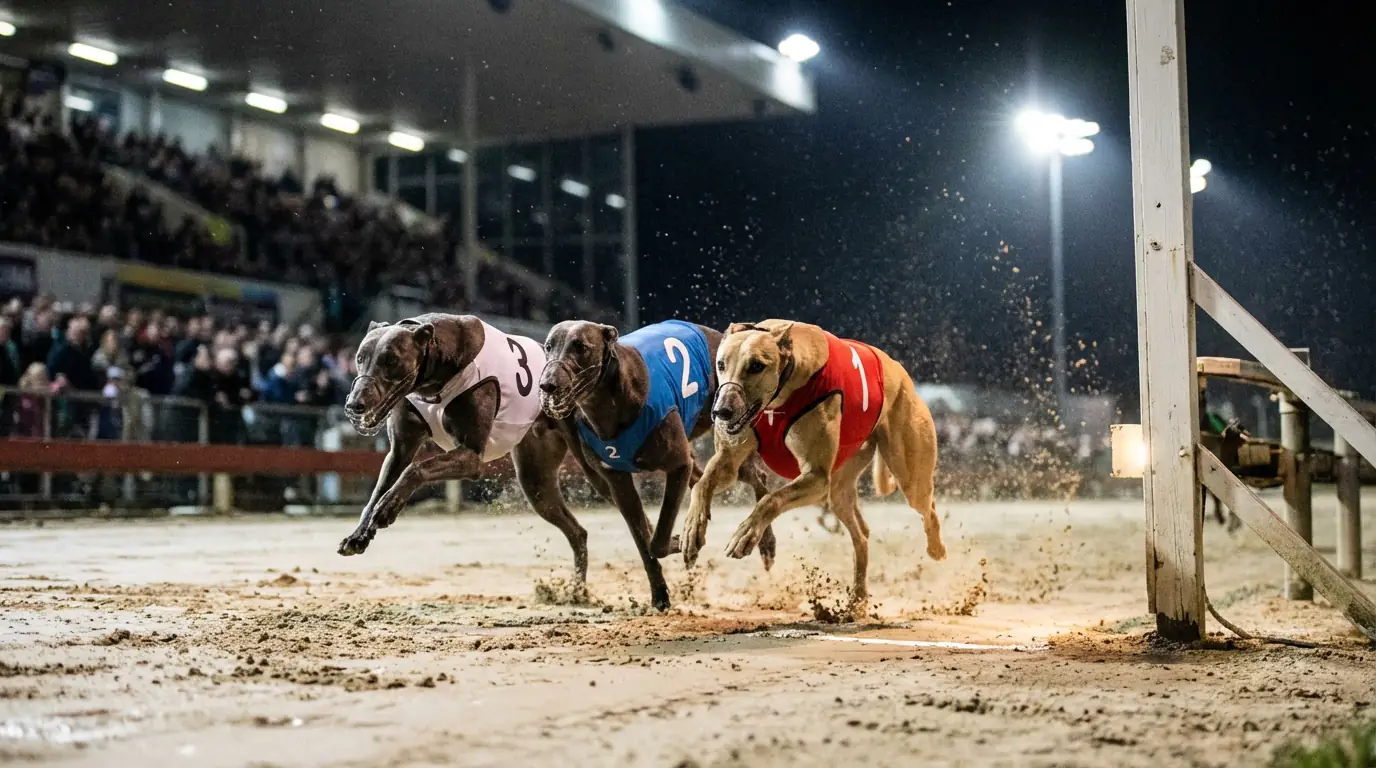
Tricast Basics: Three Dogs, One Bet
A tricast bet asks you to predict the first three finishers in a greyhound race. In its simplest form — the straight tricast — the three dogs must finish in the exact order you specified. Get all three right, in sequence, and the payout can be substantial. Get any part of it wrong, and you lose. There are no consolation prizes for getting two out of three.
The tricast is the most demanding standard bet type in greyhound racing. A forecast requires two correct selections from thirty possible combinations. A tricast requires three correct selections from one hundred and twenty possible permutations in a six-dog field. The mathematical difficulty is reflected in the dividends, which routinely reach multiples of fifty, a hundred, or several hundred times the unit stake when the result includes at least one outsider.
Despite the difficulty, tricast betting has a dedicated following among greyhound punters. The six-dog field makes it more approachable than it would be in horse racing, where field sizes can make the number of possible finish-order combinations astronomical. In a six-runner greyhound race, identifying three of the six dogs likely to fill the podium is a reasonable analytical task. The challenge lies in the ordering — and in deciding whether the potential reward justifies the higher stakes involved when covering multiple permutations.
Tricasts are available both through the tote pool at the track and through bookmakers online, where the payout is typically calculated using a computer tricast formula based on the starting prices of the three placed dogs. The returns from these two methods can differ significantly for the same result, and experienced tricast bettors often have a preference based on their typical selection profile.
Straight Tricast vs Combination Tricast
A straight tricast names three dogs in a specific finishing order: first, second, and third. There is no flexibility. Trap 2 first, Trap 5 second, Trap 1 third. Exactly that, or nothing. The appeal is cost — a straight tricast is a single bet at a single unit stake. The risk is that even a correct identification of the three best dogs produces a losing bet if the order is wrong.
The straight tricast makes sense when you have a strong view on the likely race shape. If a front-running railer in Trap 1 has clearly the best early pace, a strong closer in Trap 4 has the best calculated time but tends to start slowly, and a consistent placer in Trap 6 has a habit of finishing third at this grade, the order is suggested by the form. The front-runner leads, the closer runs it down but not quite enough, and the placer fills the frame. A straight tricast on 1-4-6 captures that specific narrative at minimum cost.
A combination tricast covers all possible finishing orders of your selected dogs. If you nominate three dogs, the combination covers all six possible arrangements of those three in the first three positions. The cost is six times the unit stake. The payout is the straight tricast dividend for whichever order actually occurs.
You can also run a combination tricast on four or more selections. With four dogs covering all permutations for first, second, and third, the number of combinations is twenty-four. With five dogs, it is sixty. The costs escalate rapidly, and the dividend needs to be very large to produce a profit. In practice, most experienced punters limit their combination tricasts to three or at most four selections.
There is a middle ground between straight and full combination that some punters use: a partial combination, sometimes called a banker tricast. You fix one dog in a specific position — say, Trap 3 to win — and then cover multiple combinations for second and third. If you fix one dog to win and select three dogs for the minor places, you have six permutations (one winner times three possibilities for second times two remaining for third). This approach is cheaper than a full combination on four dogs and reflects the common situation where you are confident about the winner but less certain about the minor placings.
Stake Calculations for Combination Tricasts
The cost of a combination tricast is determined by the number of permutations your selections create. This is straightforward mathematics, but getting it wrong means either staking more than intended or missing a permutation and losing a bet you thought was covered.
For three selections covering all first-second-third permutations, the calculation is 3 x 2 x 1 = 6 bets. At a £1 unit stake, the total cost is £6. For four selections, the calculation is 4 x 3 x 2 = 24 bets, costing £24 at a £1 unit. For five selections, it is 5 x 4 x 3 = 60 bets, costing £60. The formula is simply the number of selections multiplied by one less, multiplied by two less: n x (n-1) x (n-2).
At the minimum tote stake of 10p per line, a three-dog combination tricast costs 60p, a four-dog combination costs £2.40, and a five-dog combination costs £6.00. These lower stakes make it feasible to experiment with tricast betting without committing significant sums, and many punters use minimum-stake combination tricasts as a supplementary bet alongside their main win or forecast selections.
Banker tricasts reduce the cost by fixing one or two positions. If you fix Trap 2 as the winner and have three selections for second and third, the number of permutations is 3 x 2 = 6 (three options for second, two remaining for third). At £1 per line, that costs £6 — the same as a full three-dog combination, but with a wider net across the minor places at the expense of no flexibility on the winner.
Before placing any combination tricast, write out the permutations or use a bet calculator to confirm the total cost. It is remarkably easy to underestimate the stake on a four-dog combination, and a bet that you thought cost £12 actually costing £24 is the kind of error that damages your bankroll and your confidence in equal measure.
When Tricast Bets Make Sense
Tricast betting is not for every race, and it is not for every bettor. It suits situations where you have a clear view of the likely top three but the ordering is uncertain, and where the expected dividend is large enough to compensate for the high cost of covering multiple permutations.
The ideal tricast race has a few defining characteristics. First, it has a clear hierarchy within the field. If three dogs have distinctly better form than the other three, you can narrow the tricast to a manageable set of combinations without worrying that an outsider will spoil the podium. Second, it is a formful race — a graded contest where the dogs have run recently, at the same track, over the same distance. The more data you have, the more confidently you can assess the likely finishing positions.
Tricast betting is less effective in open races, where the dogs may be unfamiliar with each other and the form lines are harder to compare. It is also risky in races with poor seeding or unfavourable draw configurations, where first-bend interference is likely to scramble the anticipated running order.
From a pure value perspective, tricasts are most rewarding when the third-placed dog is an outsider. The tricast dividend is heavily influenced by the price of the third dog: a podium of favourite-second-favourite-outsider pays dramatically more than favourite-second-favourite-third-favourite. If your analysis suggests a mid-priced dog is likely to fill the frame — perhaps a consistent placer that the market undervalues because it rarely wins — including it in your tricast at the expense of a shorter-priced rival can significantly boost the expected return.
A practical guideline: restrict tricast betting to races where you can confidently identify three contenders, and where the total stake on your combination does not exceed what you would normally risk on a single well-researched win bet. The tricast should be an extension of solid analysis, not a replacement for it.
Three in a Row: Worth the Risk?
The honest answer is: sometimes. Tricast betting demands more precision than any other standard bet type, and the strike rate will be lower than for win or forecast bets even among skilled form readers. But the average return per winning bet is correspondingly higher, and for punters with a genuine ability to identify the top three dogs in a race, the long-term mathematics can be favourable.
The key is discipline. Tricast betting rewards selectivity over volume. A punter who places one carefully researched combination tricast per meeting will, over time, outperform the punter who scatters tricast bets across every race in the hope of landing a big dividend. The big dividend will come — but only if the losses from unsuccessful attempts are controlled.
Keep your unit stakes small. Track your results meticulously. And treat every tricast bet as a separate proposition that must be justified by the specific form, draw, and race conditions on the card in front of you. The three dogs finishing first, second, and third in a greyhound race are not random. They are the product of ability, circumstance, and starting position. If you can read those inputs accurately, the tricast is one of the most rewarding bets in the sport.
