

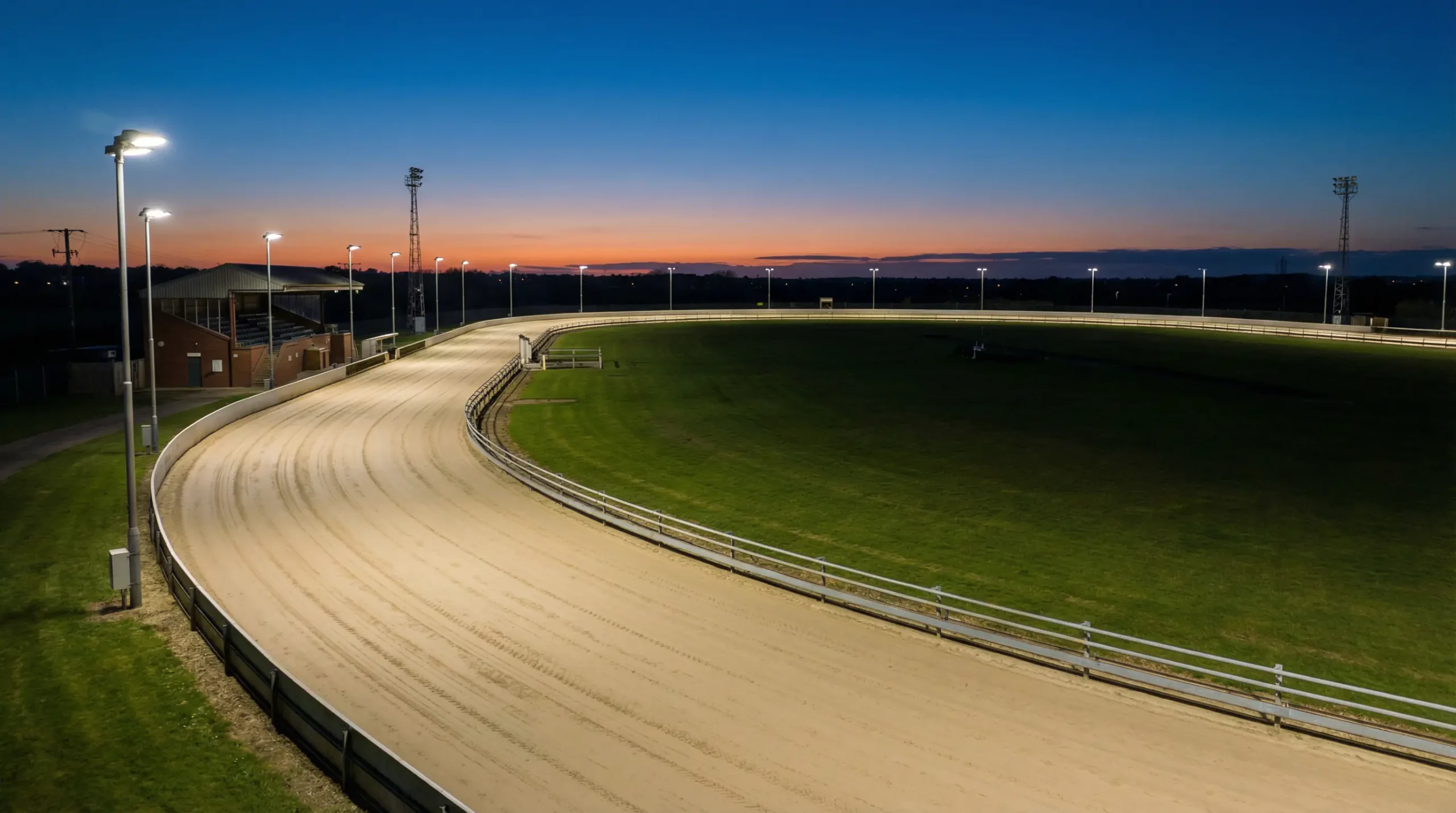
Why Track Differences Matter for Bettors
Not all greyhound tracks are the same. The circumference, bend radius, run-up distance, surface composition, and drainage characteristics vary between venues, and these physical differences directly affect racing outcomes. A dog that excels at one track may struggle at another, not because its ability has changed but because the track geometry favours a different running style. Bettors who treat all tracks as interchangeable are missing a variable that influences results more consistently than most form indicators.
Track characteristics affect the trap draw differently at each venue. A track with a short run-up to the first bend amplifies the inside trap advantage, because the dogs have less time to sort themselves out before the bend forces them into a single line. A track with a long run-up — like Doncaster, with its 105-metre straight — dilutes that advantage and gives dogs in wider traps a fairer chance to establish position. Knowing the run-up distance at the track you are betting on is one of the simplest and most actionable pieces of information in greyhound handicapping.
When a dog transfers from one track to another, the change in environment can be dramatic. A dog that has built its form on a large, galloping track may find a tight, sharp venue uncomfortable, and vice versa. The form figures carry across on the racecard, but they were produced on a different canvas. The punter who recognises this and adjusts their assessment accordingly has an edge over the one who takes the form at face value.
Track familiarity is a measurable advantage for dogs and trainers alike. A dog that has raced twenty times at its home track knows the bends, the surface, and the starting positions. A visitor running for the first time is adapting in real time. Trainers who are based close to a track and race there regularly accumulate knowledge about surface behaviour, seeding tendencies, and optimal race conditions that visiting trainers simply do not have. These advantages are not reflected in the form figures but are consistently reflected in the results.
Circumference, Bends, and Run-Up
The circumference of a greyhound track determines the size of the bends and the length of the straights, both of which influence how races are run. UK tracks range from tight, compact circuits of around 380 metres to larger, galloping tracks of 460 metres or more. The differences may sound modest, but their effect on racing dynamics is substantial.
Larger tracks have wider, more sweeping bends that allow dogs to maintain speed through the turns. The centrifugal force pushing dogs outward is reduced, which means the wide runners lose less ground and the railers gain less advantage. On a large track, the race is more open — the best dog tends to win regardless of its running style, because the track geometry imposes less penalty on any particular position.
Smaller tracks have tighter bends that compress the field and amplify the inside advantage. Dogs on the outside are pushed wider by the sharper turns, covering significantly more ground than those on the rail. At these venues, the trap draw carries more weight, and railers drawn inside have a structural edge that compensates for modest deficits in raw speed. Punters who bet primarily on tight tracks should weight the draw more heavily in their analysis than those who focus on galloping circuits.
The run-up distance — the straight distance from the traps to the first bend — is perhaps the single most important track characteristic for betting purposes. It determines how much time the field has to sort itself out before the first bend, and it directly influences the frequency of first-bend interference. A short run-up of 50 to 60 metres means the dogs reach the bend in a compressed pack, with little time for the natural separation that reduces crowding. A long run-up of 100 metres or more gives the field time to spread out, reducing the lottery element of the first bend.
Doncaster’s 105-metre run-up is among the longest in UK greyhound racing, and it contributes to the track’s reputation for producing formful results. The extended run gives dogs time to find their running lines, which means the outcome is more often determined by ability than by first-bend luck. At tracks with shorter run-ups, the first bend is more chaotic and the results are more volatile — which is useful information for bettors deciding how much confidence to place in their form analysis for a given meeting.
Surface and Drainage Variations
All UK greyhound tracks use sand-based surfaces, but the composition, depth, and drainage characteristics of the sand vary between venues. These variations affect how the surface responds to weather, how quickly it dries after rain, and how the going changes during the course of a meeting.
Some tracks are known for draining quickly, meaning the surface returns to normal going within hours of rainfall. Others hold water and can remain on slow going for days after wet weather. For bettors who follow a particular track regularly, knowing its drainage characteristics allows you to anticipate the likely going before the official report is published — if it rained overnight and the track drains slowly, you can be confident the going will be soft even before the racing manager confirms it.
Surface depth affects the energy cost of running. A deep, soft surface saps more energy than a shallow, firm one, which favours strong, powerful dogs over light-framed speedsters. Tracks that maintain a deeper sand bed tend to produce slower times and reward stamina. Those with a shallower surface produce faster times and reward pace. These differences are reflected in the calculated times published on the racecard, but only if the going allowance accurately captures the surface condition — which it does most of the time but not always.
Tracks resurface periodically, replacing worn or compacted sand with fresh material. The period immediately after a resurface can produce unpredictable times as the new sand settles, and dogs that have built their form on the old surface may need an adjustment run before they produce consistent performances on the new one. A resurface is a disruption that punters should track, because the form book becomes temporarily less reliable until the new surface stabilises.
Field Quality and Grading Standards
The quality of greyhounds racing at each track varies, and the grading standards reflect this variation. An A3 dog at a premier track like Nottingham or Romford is typically faster than an A3 dog at a smaller venue with a shallower pool of runners. The grades look the same on paper, but the absolute standard of competition they represent differs by track.
This creates opportunities and traps for bettors. A dog transferring from a strong track to a weaker one may be assigned a generous grade at its new venue — graded A4 when it would have been A2 at its previous track. Its first run at the new track, against weaker opposition, is an obvious betting opportunity. Conversely, a dog moving from a weak track to a stronger one may find itself outclassed despite an apparently reasonable grade.
The GBGB does not operate a unified national grading system, which means that each track’s grades are self-contained. The racing manager at each venue sets grades based on the local dog population, and there is no formal mechanism for translating a grade from one track to another. When a dog transfers, the new racing manager assigns a grade based on the dog’s trial times and available form, but this is a judgment call that may not perfectly capture the dog’s ability relative to the new track’s population.
For punters who bet across multiple tracks, building a mental model of relative track strength is essential. This does not need to be sophisticated — a simple ranking of which tracks attract the strongest dogs and which operate at a lower level is sufficient to inform your assessment of transfers and to calibrate your expectations when comparing form lines from different venues.
Every Track Has a Tell — Learn Doncaster’s
Specialising in one track is one of the most effective strategies in greyhound betting. By focusing your attention on a single venue, you develop the kind of detailed knowledge that generalists cannot match: how the surface behaves in different weather, which traps produce the most winners at each distance, which trainers dominate the local card, and how the racing manager’s seeding tendencies affect the draw.
Doncaster’s characteristics are distinctive. The 438-metre circumference, the 105-metre run-up, the sand surface, the stayers distance of 661 metres — all of these create a racing environment that differs meaningfully from other UK tracks. A dog that thrives at Doncaster is a dog that handles longer run-ups, sweeping bends, and a surface that can hold moisture during the Yorkshire winter. Knowing these specifics — and knowing which dogs in the Doncaster graded population are best suited to them — gives you an informational advantage that is not available from the racecard alone.
Every track in the UK has its own personality. The angles are specific, the form patterns are local, and the knowledge that comes from sustained attention to a single venue is cumulative and compounding. Pick a track. Learn its tells. The returns follow the knowledge.
