

The Official Results Process
Every greyhound race at a licensed UK track produces an official result that is recorded, verified, and published through a standardised process. This result is not simply the finishing order — it is a comprehensive data package that includes running times, sectional splits, distances between finishers, running comments for each dog, the official going, and the starting price. Together, these elements form the race record that feeds into the form book and becomes the raw material for future analysis.
The official result is determined by the judge, who is positioned at the finishing line and calls the order of finish. At modern tracks, the judge is supported by electronic timing equipment and, in close finishes, by a photo-finish camera that captures the exact moment the dogs cross the line. The judge’s call is authoritative — it determines the result for the purposes of betting settlement and the form book — and it can only be overturned by a stewards’ inquiry that finds evidence of an irregularity affecting the outcome.
The racing manager and the track’s administrative team compile the full result record after each race. This includes entering the finishing positions, the official winning time, the calculated time adjusted for the going, the sectional times where available, the distances between each finisher (recorded in lengths), and a brief running comment for each dog describing its passage through the race. The running comments are a crucial part of the record, because they explain what the raw numbers cannot — whether a dog was crowded, had a clear run, led throughout, or finished strongly from behind.
Once compiled, the result is transmitted to the GBGB’s central database and to the data providers that supply form information to bookmakers, racing media, and the public. The speed of this transmission has increased dramatically with digital technology — results are typically available online within minutes of a race finishing, and the full form record is usually updated within the hour. For bettors following a meeting in real time, the result data is effectively instantaneous.
The integrity of the results process is underpinned by multiple checks. Electronic timing removes human error from the time recording. Photo-finish technology resolves close calls with precision measured in hundredths of a second. Stewards review the running of every race and have the authority to investigate and reverse results if they find evidence of interference, misconduct, or rule breaches. The system is not infallible, but it produces a reliable, verifiable record that punters can trust as the foundation of their analysis.
Timing, Photo Finishes, and Stewards
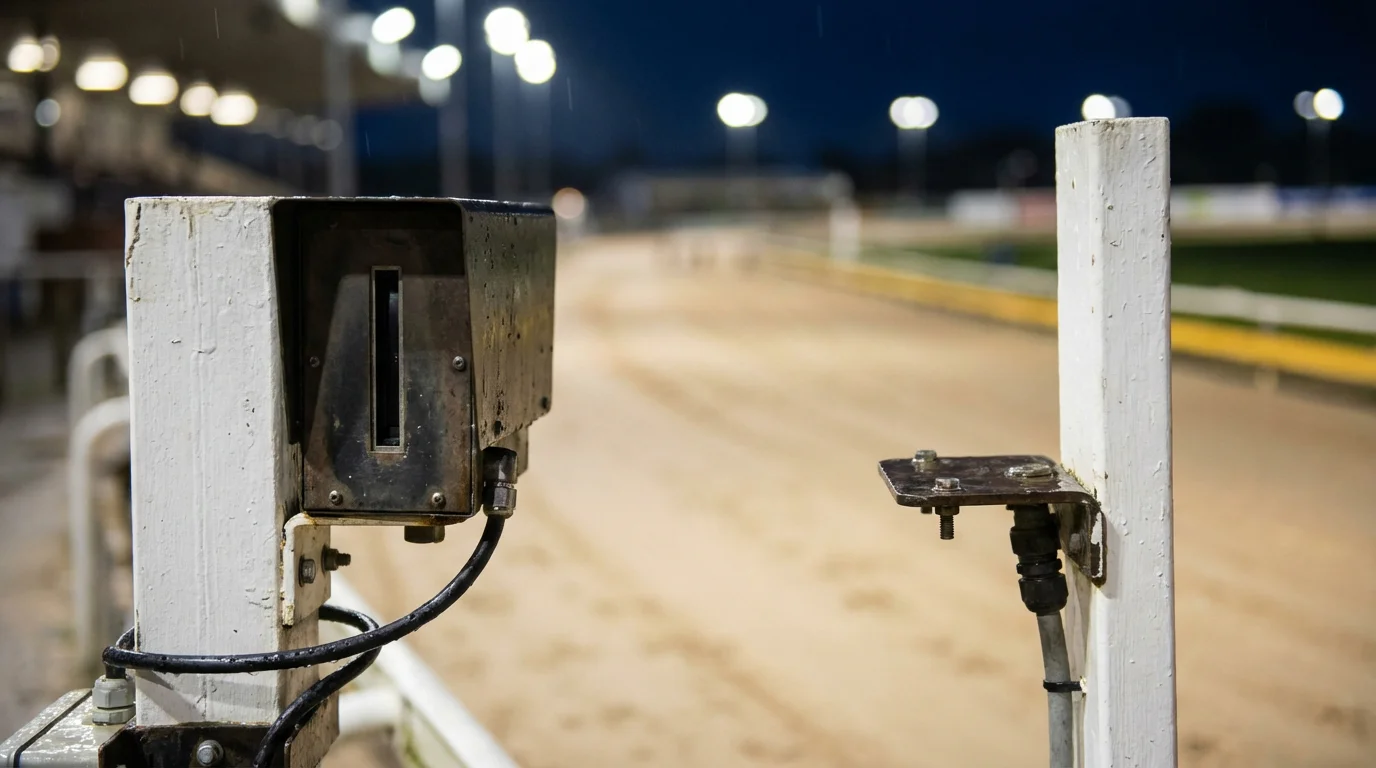
Electronic timing at UK greyhound tracks uses sensors triggered by the mechanical hare’s position and by the dogs crossing the finish line. The system records the overall race time and, at most tracks, at least one sectional split — typically the time from trap opening to the first bend. These times are recorded to hundredths of a second, providing the precision that form analysis requires.
The timing system is calibrated before each meeting and is subject to periodic inspection by the GBGB’s technical staff. Accuracy matters, because the calculated times that appear on future racecards are derived from these electronic readings. A timing error of even a tenth of a second would distort the calculated time and mislead punters who rely on it for comparative analysis. The investment in reliable timing equipment is, for the bettor, one of the most important pieces of infrastructure at any track.
Photo-finish technology captures the moment dogs cross the line using a strip camera that produces a composite image showing each dog’s nose at the exact point of crossing. In close finishes, the photo is examined by the judge to determine the official order. The photo-finish image is typically displayed on the track’s screens after a close result and is available to stewards if there is a dispute or inquiry.
Stewards are the on-course officials responsible for ensuring that each race is run fairly and in accordance with the rules. They watch every race from a vantage point above the track and review video replays if they observe potential interference, a dog running off its expected line, or any other incident that might have affected the result. A stewards’ inquiry can be called after any race, and the stewards have the authority to amend the result — including demoting a dog for causing interference or disqualifying one for a rule breach.
For bettors, a stewards’ inquiry is a period of suspended settlement. Bets are not paid out until the inquiry is resolved and the official result is confirmed or amended. The practical impact is usually minimal — most inquiries are completed within a few minutes — but the possibility of a result being changed after the race has finished is a reality of the sport that punters should be aware of, particularly in close races where interference was visible.
GBGB Records and Databases
The Greyhound Board of Great Britain maintains the central database of all licensed greyhound racing in the UK. Every race result, every dog’s form record, every grading decision, and every breeding registration is recorded in this database, creating a comprehensive archive of the sport that stretches back decades.
The GBGB database is the authoritative source for greyhound form data. The information that appears on racecards, on form websites, and in betting-shop displays originates from this database, either directly or through licensed data providers who access and redistribute the records. When you look at a dog’s form figures on a racecard, you are reading data that was compiled at the track, transmitted to the GBGB, and then distributed to the platform you are using.
Access to the GBGB’s records is available through their official website, where punters can look up individual dogs, review their full racing history, check breeding records, and verify form data. The level of detail available is impressive — you can trace a dog’s career from its first trial to its most recent race, see every time it has been graded, and review its performance at every track it has visited.
Third-party form databases and racing information services supplement the GBGB’s official records with additional analysis, statistics, and tools. These services often add value through features like calculated time comparisons, trap draw statistics, trainer form tables, and speed ratings that go beyond the raw data in the GBGB’s database. For serious punters, a combination of the official GBGB records and one or more third-party services provides the most complete analytical toolkit.
Where to Find Greyhound Results Online
Greyhound results are widely available online, and the speed of publication means that results from any UK meeting are accessible within minutes of the race finishing. Several sources provide this information, each with its own strengths.
The GBGB’s own website publishes official results from all licensed meetings. This is the definitive source, and the data includes all the elements of the official result record: finishing positions, times, going, distances, and running comments. The interface is functional rather than polished, but the data is complete and accurate.
Specialist racing websites like Sporting Life and Timeform provide results with additional context — expert analysis, speed ratings, form commentary, and integration with their broader form databases. These sites are the most popular destination for punters who want results presented alongside the analytical tools they use for studying future racecards. The trade-off is that some features may require a subscription or account registration.
Bookmaker websites and apps display results for the meetings they cover, typically integrated with the betting interface so that you can review a result and then navigate directly to the next race’s card. The depth of data varies by bookmaker — some show full form details while others show only the finishing order and winning time — but the convenience of having results within the platform you use for betting is a practical advantage.
Social media accounts operated by tracks, trainers, and racing media also provide rapid results, often accompanied by video clips of the race and informal commentary. These sources are useful for staying current with results in real time but should not be relied on for the precise data that form analysis requires. For the detail, use the official and specialist sources.
The Paper Trail Behind Every Race
Every greyhound race generates a permanent record. The finishing positions, the times, the going, the running comments, the stewards’ decisions — all of it is documented, stored, and made available to anyone who wants to study the sport’s history or analyse its form. This paper trail is one of greyhound racing’s great strengths as a betting medium. The data is abundant, accessible, and standardised.
The punter who engages with this data seriously — who studies results not just to see who won but to understand how and why — is working with a richer information set than most competitors in the betting market. The results are published for everyone, but the analysis of those results is not equally distributed. The depth of the record rewards the depth of your attention.
The next time you glance at a result, look past the winning trap number. Read the times. Read the comments. Read the distances. Every race tells a story, and the official record is the only version that is guaranteed to be accurate.
