

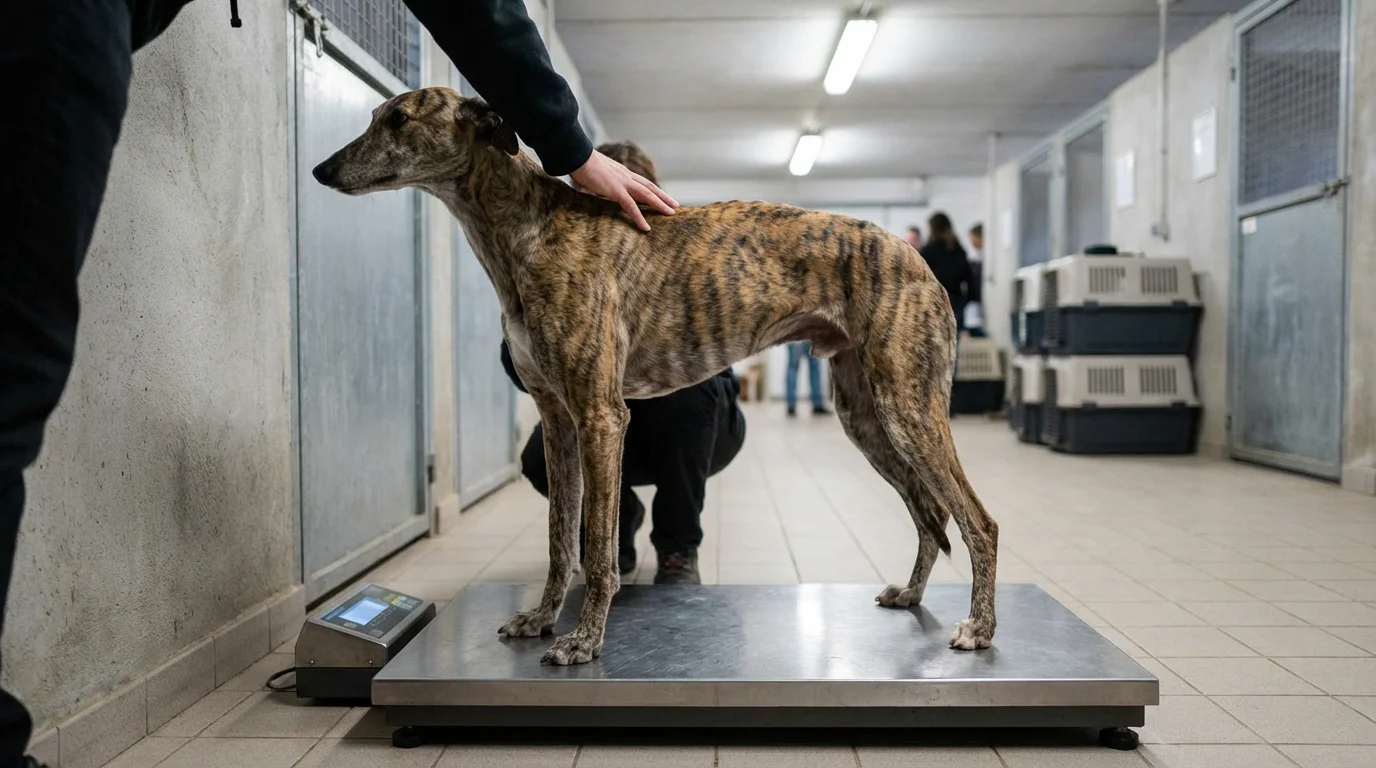
The 1kg Rule: Why Kennelling Weight Matters
Every greyhound that races at a licensed UK track is weighed before the meeting as part of the mandatory kennelling process. The dog’s weight is recorded and published on the racecard, giving punters a data point that most other sports simply do not offer. In greyhound racing, you know exactly how much each competitor weighs on race day, and that information tells you something about the dog’s physical condition.
The critical regulation is the 1 kilogram rule. Under GBGB rules, if a greyhound’s kennelling weight differs by more than 1 kilogram from its last recorded racing weight, the racing manager must be notified, and the dog may be subject to additional scrutiny before being cleared to race. In some cases, a weight variation outside this range can result in the dog being withdrawn. The rule exists to protect animal welfare — a significant weight swing can indicate illness, poor feeding, or an underlying health issue — but it also has practical implications for bettors.
A dog racing within its normal weight range is, by definition, in a physically stable condition. The kennelling weight confirms that nothing dramatic has changed since its last run. When the weight shifts — even within the permitted 1kg window — the change is visible on the racecard and invites interpretation. Is the dog carrying a little extra condition after a rest period? Has it lost weight after a recent illness? Is the trainer deliberately bringing it in lighter for a sprint or heavier for a stayers race?
The racecard typically shows both the dog’s current kennelling weight and the weight from its previous run. Some services also show a longer weight history, allowing you to track trends over several weeks or months. This longitudinal data is more useful than any single reading, because it reveals whether a weight change is a one-off fluctuation or part of a consistent trend.
Weight data is one of the most accessible yet least utilised form indicators in greyhound racing. Many casual punters glance at it and move on, treating it as administrative detail. Serious punters treat it as a physical status report — a reading of the dog’s condition that no amount of form analysis from running times alone can provide.
What Weight Gain or Loss Signals
Weight fluctuations in greyhounds are not random. They are physiological signals, and interpreting them correctly requires understanding what the changes typically indicate in the context of a racing animal.
A modest weight gain — half a kilogram or so — after a rest period is normal and generally positive. The dog has been fed well, has recovered from its previous exertions, and comes into the race in good physical condition. Trainers often target a small weight gain as a sign that a dog is fresh and ready. If you see a dog that has been rested for two or three weeks and has gained 0.3 to 0.5 kilograms, the weight change supports the idea that the layoff was planned and the dog has been well managed.
A larger weight gain — approaching or exceeding 1 kilogram — is more ambiguous. It can indicate a dog that has been out of training for an extended period, perhaps recovering from injury, and is returning to racing carrying excess condition. These dogs may not be at peak fitness despite their trainer declaring them ready. The weight tells you what the racecard cannot: the dog may need a race or two to shed the extra condition and return to its best.
Weight loss is the more concerning signal. A dog that has lost 0.5 kilograms or more since its last run may be dealing with a health issue, stress, poor feeding, or the cumulative effect of a demanding racing schedule. Racing greyhounds are lean, powerful athletes, and even small losses of body mass can represent a significant reduction in muscle condition and energy reserves. A dog that has lost weight across three consecutive racecards is a dog in declining physical shape, and that trend should override any positive signals from its recent running times.
The context of the weight change matters as much as the magnitude. A 0.3kg loss after a dog’s first run at a new track might simply reflect the stress of kennelling in an unfamiliar environment. A 0.3kg loss after five consecutive weekly races might reflect cumulative fatigue. The number is the same, but the interpretation is different.
Female greyhounds can show more pronounced weight fluctuations than males, particularly when approaching or recovering from a season. These hormonal weight changes are distinct from condition-related changes and require specific knowledge to interpret correctly. A female dog losing 0.5kg is not necessarily declining — it may be approaching a season, after which it will typically be rested and return at or above its usual weight.
Reading Weight Data on the Racecard
Weight data is presented on the racecard in a standard format, though the exact layout varies between providers. The typical display shows the dog’s name, its current kennelling weight, and the weight from its previous run. The difference between the two is sometimes calculated for you; on other racecards, you need to do the subtraction yourself.
The weight is recorded in kilograms to one decimal place. A greyhound might be listed at 32.4 kilograms for today’s race with a previous weight of 32.1 kilograms, showing a gain of 0.3 kilograms. This level of precision — a tenth of a kilogram — matters, because the dogs themselves are lean enough for small changes to be physiologically meaningful. A 0.5kg change on a 32kg dog represents roughly 1.5 percent of its body mass, which is proportionally significant for an animal running at peak exertion.
When studying the racecard, build a habit of scanning the weight column for every runner in the race before diving into the form. Identify any dog showing a notable change — half a kilogram or more in either direction — and flag it for closer examination. The weight will not tell you what is happening, but it will tell you that something has changed, and that prompt alone is valuable.
Some racecard services and databases allow you to view a dog’s full weight history across multiple races. This is the most useful format for weight analysis, because it shows you the trend. A dog that has weighed between 30.8 and 31.2 kilograms for ten consecutive races is in stable condition. The same dog suddenly racing at 30.3 kilograms is telling you something. Cross-reference the weight drop with its recent form, any time off, and the trainer’s patterns to form a view on whether the change is benign or concerning.
One practical point: kennelling weight is recorded at the track on race day, not at the trainer’s kennel. The dog may have been fed or not fed before travelling, may have been kennelled for varying lengths of time, and may respond to the stress of travel differently on different days. Small fluctuations of 0.1 or 0.2 kilograms may reflect these logistical variables rather than genuine changes in the dog’s condition. Focus on changes of 0.3 kilograms or more, and particularly on changes that form a pattern across multiple races.
Weight as a Betting Indicator
Weight is not a standalone betting signal. A dog that has gained 0.4 kilograms is not automatically a better bet than one that has lost the same amount. But weight data, combined with other form indicators, can confirm or challenge the picture that running times and finishing positions paint.
The strongest betting application of weight data is as a filter for dogs returning from a layoff. A rested dog that comes back at a weight close to its career average is more likely to perform to form than a rested dog that comes back significantly lighter or heavier. The weight tells you something about how the rest period has been managed and whether the dog is physically ready to compete at its usual level.
Weight trends also help identify dogs that are being over-raced. A dog that has been running every week for six weeks and has lost 0.3 kilograms at each weighing is shedding condition progressively. Its form might still look acceptable — it might still be finishing second or third — but the weight trend suggests that a sharp decline is coming. Opposing this dog at short odds, before the form catches up to the physical reality, is a valid betting strategy.
Conversely, a dog that has been freshened up with a two-week break and returns at its optimum weight is a positive indicator. If the form was good before the rest and the weight confirms that the break has been productive, the conditions are right for a strong return run. The market may not give enough credit to the physical freshness if it focuses primarily on the dog’s last-run form, which was from before the break.
Think of weight as one instrument in a dashboard. It does not fly the plane alone, but ignoring it means you are missing a reading that the other instruments cannot provide.
Every Gram Counts at the Traps
Greyhound racing is a sport of tiny margins. Half a length separates winners from losers, and a tenth of a second separates grades. In that context, weight — a direct measure of the animal’s physical condition — deserves more attention than most punters give it.
The dog that arrives at the track at its optimal racing weight, stable and consistent with its recent history, is more likely to perform to its known level than a dog whose weight has swung outside its normal range. That is not a guarantee. It is a probability, and probabilities are what betting is built on.
Add weight to your pre-race routine. It takes thirty seconds to scan the column, and the information it provides cannot be found anywhere else on the racecard.
