

Non-Runner Rules in UK Greyhound Racing
A non-runner is a greyhound that was originally declared to race but is withdrawn before the traps open. In UK greyhound racing, non-runners occur for a variety of reasons — injury, illness, being on season for female dogs, failing the pre-race kennelling inspection, or a trainer’s late decision to withdraw. Whatever the cause, the effect on the race and on the betting market is immediate and significant.
Under the rules administered by the Greyhound Board of Great Britain, dogs must pass a veterinary and kennelling inspection before being cleared to race. This inspection takes place at the track before the meeting, and any dog that fails — due to injury, weight discrepancy, lameness, or any other health concern — is declared a non-runner. Trainers can also withdraw a dog voluntarily before the final declaration stage, though late withdrawals after declarations have closed are subject to regulations and may require an explanation to the racing manager.
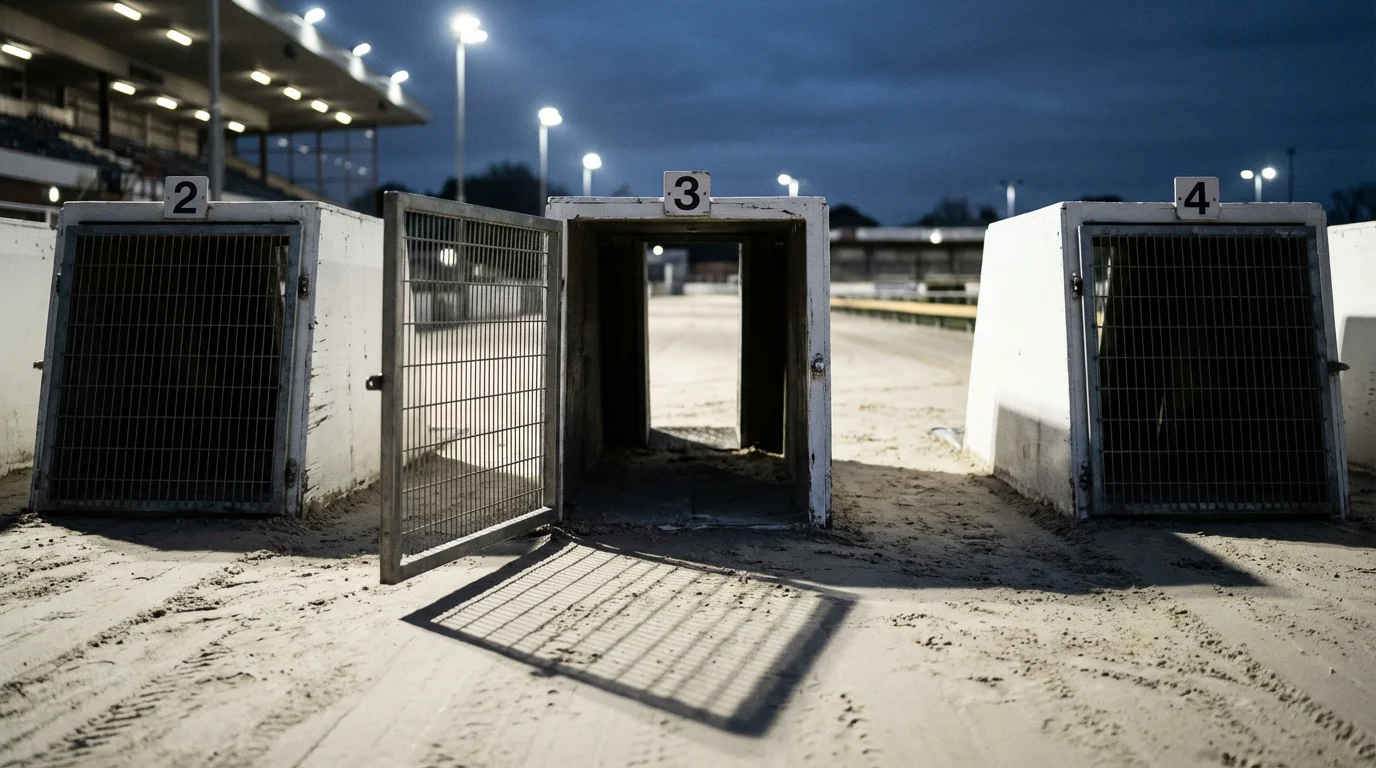
When a non-runner is declared, the race runs with fewer than six dogs. Five-runner races are the most common reduced-field scenario, though races with four runners occur occasionally. If too many dogs are withdrawn and the field falls below the minimum number required, the race may be void entirely. The vacant trap remains physically empty during the race — the lid opens, but no dog exits — which changes the dynamics of the race in ways that matter for bettors.
The timing of the withdrawal determines how it affects the betting market. A dog withdrawn well before the meeting begins is usually removed from the market cleanly, and the prices on the remaining dogs are adjusted. A late withdrawal — one that occurs after the on-course betting has opened — creates a more complicated situation, because bets have already been placed on the withdrawn dog and the market must be corrected mid-flow.
For punters, the non-runner announcement is not just administrative information. It changes the race. A six-dog race and a five-dog race are different propositions, and the specific dog that has been withdrawn — its trap position, its running style, its role in the race — determines how the remaining field is affected. Treating a non-runner as a neutral event is a mistake that costs money.
Rule 4 Deductions and Refund Policies
When a greyhound is withdrawn after the final declarations and the betting market has already formed, bookmakers apply Rule 4 deductions to bets on the remaining runners. This is a standardised mechanism that adjusts payouts downward to reflect the reduced field and the removal of a competitor.
Rule 4 deductions are expressed in pence per pound and are determined by the odds of the withdrawn dog at the time of withdrawal. The shorter the price of the non-runner, the larger the deduction. If a 2/1 favourite is withdrawn, the deduction is substantial — around 30 pence in the pound — because removing the most likely winner significantly improves the chances of every other dog. If a 10/1 outsider is withdrawn, the deduction is minimal — perhaps 5 pence in the pound — because its removal barely changes the probability landscape.
The deduction scale is set by the industry and is not negotiable. A 30p Rule 4 deduction means that if your winning bet would have returned £10, you receive £7 instead. The deduction applies only to bets placed before the non-runner was declared. Bets placed after the withdrawal are settled at revised odds that already account for the reduced field, so no Rule 4 deduction applies.
If you backed the non-runner itself, your bet is void and your stake is returned in full. There is no penalty for having backed a dog that did not run — you simply get your money back. This applies to all bet types: win, each way, forecasts, and tricasts. For each way bets on the non-runner, both the win and place stakes are returned.
The practical implication for bettors is clear: late non-runners cost you money if you have already backed another dog in the race. The Rule 4 deduction reduces your potential winnings even though you had no control over the withdrawal. This is one of the arguments for waiting until closer to race time before placing your bets, particularly in races where one or more dogs are reported as doubtful runners in the pre-meeting declarations.
Some online bookmakers offer “non-runner, no bet” guarantees on certain greyhound markets, meaning that if there is a non-runner in the race, all bets on the remaining dogs are void rather than subject to Rule 4 deductions. This is a favourable term for the bettor and is worth seeking out, though it is not universally available and may apply only to specific meetings or bet types.
Reserve Runners: What Happens Next
When a greyhound is withdrawn from a race, a reserve runner may take its place. Reserve dogs are listed on the racecard alongside the main six, and they are brought into the race to maintain a full field. The reserve inherits the trap of the withdrawn dog, regardless of whether that trap suits the reserve’s natural running style.
This trap inheritance is important. A reserve runner seeded as a wide runner might find itself in Trap 1 because the withdrawn dog was a railer. The reserve has not been seeded for that trap — it has been placed there by circumstance. Its recent form from its natural outside position may be entirely misleading when it is starting from the inside for the first time. Conversely, a railer entering as a reserve in Trap 6 faces the same mismatch problem.
Reserve runners are typically dogs of slightly lower quality than the original field — they are reserves for a reason. But “slightly lower quality” does not mean they cannot win, especially if the trap they inherit happens to suit them or if the withdrawal of the original dog has disrupted the seeding balance of the race in a way that benefits the reserve’s running style.
The market usually prices reserve runners as outsiders, reflecting both their lower perceived quality and the uncertainty around the trap mismatch. This creates occasional value. A reserve runner who is a genuine A4-grade animal entering an A5 race — because the withdrawn dog was also A5 and the reserve was next on the list — may be underpriced at 8/1 or 10/1. The market sees “reserve runner” and assumes weakness. The form book may tell a different story.
Not all withdrawals result in a reserve being called up. If the withdrawal occurs too late for a reserve to be kennelled and prepared, or if no suitable reserve is available, the race runs with a reduced field. The decision rests with the racing manager, and it can vary by track and by the specific circumstances of the withdrawal.
Impact on Forecasts, Tricasts, and Trap Bets
Non-runners have a disproportionate effect on forecast and tricast bets. In a six-dog race, there are thirty possible forecast combinations and one hundred and twenty possible tricast permutations. Remove one dog, and the numbers drop to twenty forecast combinations and sixty tricast permutations. The reduction in possible outcomes means that each remaining combination is more likely to occur, which in theory should reduce dividends — and in practice, it usually does.
If you placed a forecast or tricast that included the non-runner as one of your selections, the bet is void and your stake is returned. If the non-runner was not one of your selections, the bet stands, but the reduced field changes the probability of your combination occurring. Your selected dogs still need to finish in the right order, but they are now competing against four rivals instead of five. This increased probability is reflected in lower pool dividends, which can be disappointing if you expected a larger return.
Trap challenge bets are affected differently. If the non-runner was from your selected trap, you lose one potential winning opportunity from the card. The remaining races still count, but you are now competing against traps that have a full set of runners while your trap has a gap. If the non-runner was from a rival trap, you gain a marginal advantage, because that trap also loses one opportunity. The net effect depends on the quality of the withdrawn dog and the specific race it was removed from.
Accumulator bets that include a selection from the affected race are treated as follows: the non-runner leg is void and the accumulator is recalculated as if that leg did not exist. A four-fold becomes a treble. The potential return shrinks, but the bet is not entirely lost. If your non-runner selection was the only leg that looked uncertain, the withdrawal might actually improve your overall position — though the reduced return is the price you pay.
The broader lesson is that non-runners introduce volatility into every bet connected to the affected race. If you specialise in forecast or tricast betting, monitoring the declarations and being prepared for late withdrawals is a practical necessity rather than an optional extra.
One Empty Trap Changes Everything
An empty trap reshapes the dynamics of a greyhound race in ways that are easy to underestimate. The physical absence of a dog from one starting position changes the space available at the first bend, alters the running lines of the remaining dogs, and shifts the probability of interference in directions that the original form analysis did not account for.
If Trap 3 is empty, the dogs in Traps 1 and 2 have more room on the inside, while the dogs in Traps 4, 5, and 6 may find a wider gap opening on the rail side of the bend. If Trap 1 is empty, the dog in Trap 2 effectively inherits the inside position and the shortest route to the bend. Each vacancy creates a specific spatial change, and the dogs that benefit are those whose running style allows them to exploit the extra room.
Do not simply reprice the remaining dogs and bet as normal. Ask how the empty trap changes the likely first bend. Then ask which dogs benefit and which lose the tactical cover that the withdrawn runner would have provided. The answer to those questions is where the betting value sits after a non-runner has reshaped the race.
